
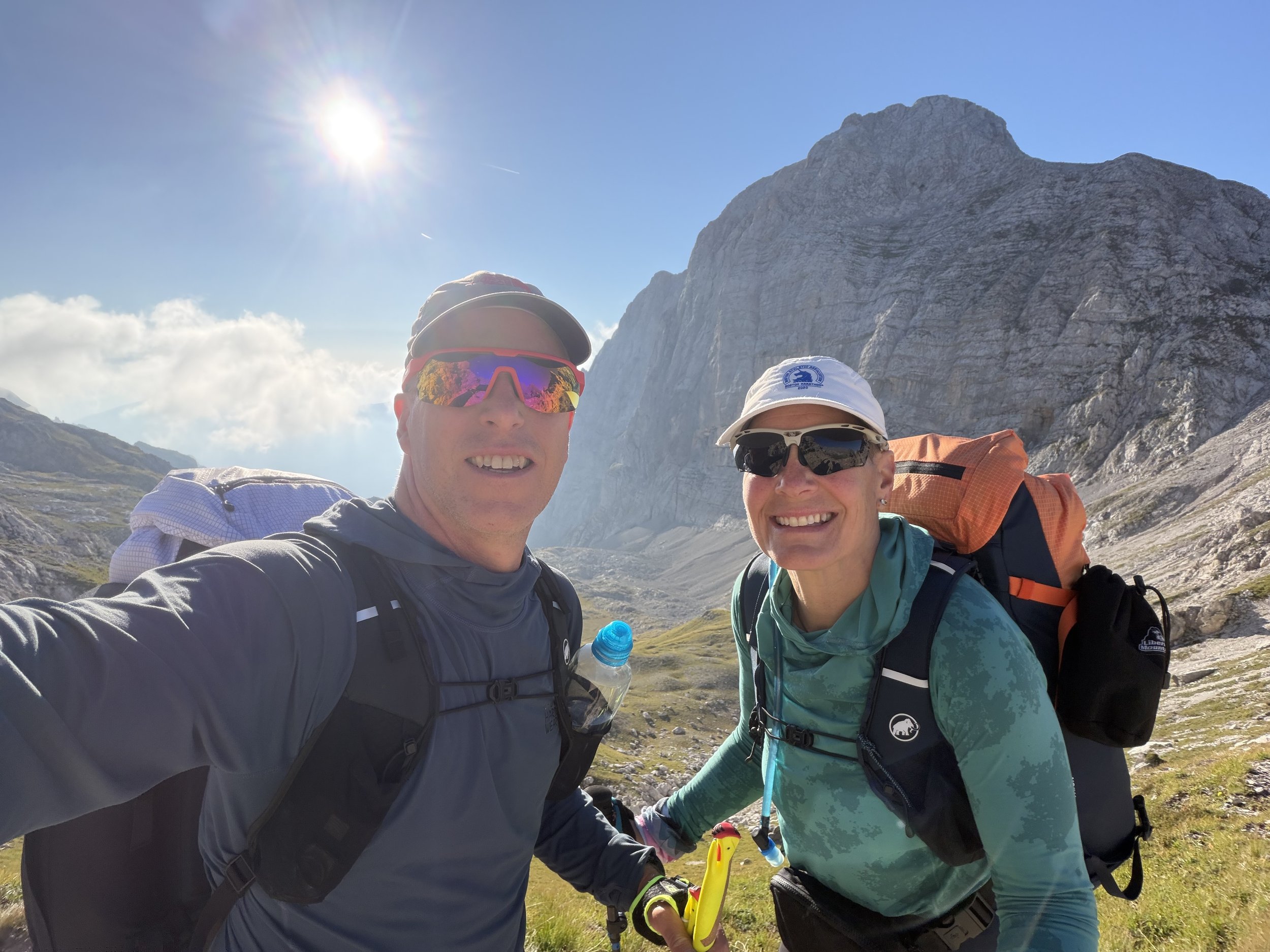
Guest blog written by Amy Margolis.
Over four days, David and I travelled between mountain huts through steep, rocky terrain, loose scree and enormous boulder fields. We climbed challenging via ferratas, crossed glaciers in poor visibility and spent long hours moving through exposed terrain. It was spectacular—but it was also more physically and mentally demanding than the distances on the map might suggest.
By our fourth morning, after three big days and some stomach trouble, we changed our plans and descended to Madonna di Campiglio. It was the right decision. Looking back, our experience reinforced one of the most important lessons of planning a hut-to-hut hike in the Brenta: technical difficulty, exposure and cumulative fatigue matter at least as much as kilometres and elevation.
This is how our four-day adventure unfolded.
A note about this route
This was our personal experience in the conditions we encountered. The routes described include exposed scrambling, protected via ferrata sections and glacier crossings. Conditions and route requirements can change. Hikers should confirm current conditions, carry the appropriate via ferrata equipment and have the necessary skills and experience—or travel with a qualified guide.

Our Brenta hut-to-hut route at a glance
- Duration: 4 days / 3 rifugio nights
- When we hiked: September 2026
- Longest day: Approximately 10 hours
- Technical terrain: Via ferratas, exposed scrambling and glacier crossings
- Experience required: Experienced and equipped mountain hikers
- Start: Grostè cable car
- Finish: Madonna di Campiglio
| Day | Route | Overnight |
|---|---|---|
| 1 | Grostè cable car → Route 318 → Rifugio Tuckett → Route 305 → Route 305B and Via Ferrata SOSAT | Rifugio Brentei |
| 2 | Rifugio Brentei → Route 318 → Rifugio Pedrotti → Route 358 and Via Ferrata Livio Brentari → glacier crossing | Rifugio Agostini |
| 3 | Rifugio Agostini → Route 320 → Rifugio Pedrotti → Route 305 and Via Ferrata Bocchette Centrali → glacier crossing | Rifugio Alimonta |
| 4 | Rifugio Alimonta → Route 318 → Rifugio Casinei → Route 317 → Rifugio Vallesinella → bus to Madonna di Campiglio | Hotel Crozzon |
Grostè to Rifugio Brentei via Via Ferrata SOSAT
Grostè cable car → Rifugio Tuckett → Via Ferrata SOSAT → Rifugio Brentei
Our first day began with the Grostè cable car, giving us quick access to the high mountains. From there, we followed Route 318 towards Rifugio Tuckett before continuing on Route 305 and then 305B via the Via Ferrata SOSAT to Rifugio Brentei.
It did not take long to understand why walking times are more useful than distances in this part of the Dolomites. The terrain was rocky, steep and slow-going, with loose scree and huge boulder fields in addition to the via ferrata itself. A distance that might look modest on paper can become a serious mountain day once the terrain is taken into account.

The day was challenging, but it felt manageable—and it gave us an exciting introduction to the Brenta. We reached Rifugio Brentei in time for a shower, played a few hands of cards and finished the evening with a delicious, very welcome dinner.
At that point, Day 1 felt like a success and a taste of what was ahead. We did not yet appreciate how much the effort would accumulate over the following two days.
Rifugio Brentei to Rifugio Agostini via Via Ferrata Livio Brentari
Rifugio Brentei → Rifugio Pedrotti → Via Ferrata Livio Brentari → glacier crossing → Rifugio Agostini
Day 2 took us from Rifugio Brentei back towards Rifugio Pedrotti on Route 318. We then continued on Route 358 via the Via Ferrata Livio Brentari, crossed a glacier and finished at Rifugio Agostini.
This day proved considerably more demanding than the first. We had a substantial climb before we even reached the via ferrata, and the ferrata itself fully lived up to the challenge.
Then came the glacier crossing. Fog had reduced visibility, there were no route markers visible to us, and navigation became difficult. It was a sobering reminder that a route can change character quickly when visibility deteriorates. A crossing that may appear straightforward in good conditions can feel very different when the terrain and the way ahead are obscured.

Despite the long and demanding day, we arrived at Rifugio Agostini in time for the now-familiar rhythm of showers, cards and a well-earned dinner. We were tired, but we had completed another unforgettable day in the Brenta.
Rifugio Agostini to Rifugio Alimonta via Via Ferrata Bocchette Centrali
Rifugio Agostini → Rifugio Pedrotti → Via Ferrata Bocchette Centrali → glacier crossing → Rifugio Alimonta
Day 3 was the hardest day of the trip—and one of the most mentally demanding days I have ever experienced in the mountains.

From Rifugio Agostini, we followed Route 320 towards Rifugio Pedrotti. We then took Route 305 via the Via Ferrata Bocchette Centrali, crossed another glacier and continued to Rifugio Alimonta.
The day pushed me far outside my comfort zone. There was unprotected scrambling, extreme exposure and another glacier crossing that felt extremely precarious in the conditions. Over ten hours, the technical terrain and sustained concentration gradually wore me down.

David was my rock throughout the day. When my confidence faltered, his calm support helped me keep moving. Day 3 broke me down in a way I had not expected—but it also became the day I felt most proud of completing.
That is one of the contradictions of the mountains: the days that test us most deeply can become the ones that stay with us most vividly. Pride, relief, fear and exhaustion can all exist at once.
But completing a hard day does not mean the best decision is to repeat it immediately. By the time we reached Rifugio Alimonta, three consecutive technical days had taken a significant toll.

Changing our plan and descending to Madonna di Campiglio
Rifugio Alimonta → Rifugio Casinei → Rifugio Vallesinella → bus to Madonna di Campiglio
Our original plan did not end with a direct descent to town. But after three long, intense days—and with some gastrointestinal distress added to the fatigue—we knew that another major climbing and via ferrata day was not the right choice.
Instead, we descended from Rifugio Alimonta on Route 318 to Rifugio Casinei, continued on Route 317 to Rifugio Vallesinella, and took the bus to Madonna di Campiglio.
Calling it an “easy day” would be misleading. The roughly five miles of continuous, steep descent was still hard on tired legs. But it did not demand the same sustained concentration as another exposed day of climbing, via ferrata and glacier travel.

We reached Madonna di Campiglio and checked into Hotel Crozzon, where excellent food and a glorious spa gave us exactly the recovery we needed after three epic days in the mountains.
Changing the plan was not a failure. It was a considered response to our condition and the experience of the previous days. Mountains do not reward stubborn adherence to an itinerary; sometimes the strongest decision is to take the safer, more appropriate option.
What I would plan differently next time
In hindsight, I would not schedule three consecutive days combining big mileage, challenging climbs, sustained exposure, via ferratas and glacier crossings.
I would plan a less intense third day, allowing time to recover, followed by one more substantial mountain day before the final descent to town. That would create a better rhythm and leave more capacity to enjoy the technical sections, rather than reaching them with fatigue already accumulating.
Is a hut-to-hut hike in the Brenta right for you?
The Brenta Dolomites are extraordinary. The landscape is dramatic, the routes feel adventurous and the rifugios provide the camaraderie and comfort that make hut-to-hut travel so memorable.
But this particular itinerary should not be assessed like an ordinary hiking route. Our days included via ferratas, extreme exposure, unprotected scrambling and glacier crossings. It demanded technical competence, sound judgement and a willingness to adapt.
For experienced and appropriately equipped hikers, the Brenta can offer an unforgettable journey. For anyone unsure about the technical terrain, travelling with a qualified local guide—or choosing a less committing itinerary—would be a sensible way to experience the region.
My lasting memory will be a mixture of awe and pride: spectacular mountains, hard-earned arrivals at welcoming rifugios, and the knowledge that I was capable of more than I expected. Just as importantly, the trip reinforced that good mountain judgement is not only about continuing. It is also about recognising when the plan needs to change.
Help choose our next trail
Want to plan your own Brenta Dolomites hike?
Vote for the Brenta Dolomites to be added to The Hiking Club planning platform. Your vote helps us decide which trail to build next.
Vote for the Brenta Dolomites No email or login required