Hiking the Tour du Mont Blanc with kids

The Smith family hiked the full circuit of the Tour du Mont Blanc in July 2024, staying in gites, mountain huts, and hotels. They carried everything they needed on their backs (there was no luggage transfer). Read Meggan’s tips about preparing and hiking a multi-day hike with kids.

Hiking the Tour du Mont Blanc with kids

Attempting your first multi-day hike can be intimidating. Doing it with kids adds a layer of complexity. I hope in sharing our experience hiking the Tour du Mont Blanc with our kids (a 10-year-old son and a 12-year-old daughter) that you will have a better idea of what a trekking adventure in the mountains might entail for your family.   


Of course, every child is different, and you know your child(ren) best. Our family was already fairly active, and most family vacations involved some physical activity, especially hiking when exploring the beautiful National Parks across the United States. However, none of us had completed a multi-day hike, and most of our hikes in the Eastern United States did not exceed 1,000 ft elevation gain, so hiking the Tour du Mont Blanc (TMB) in the Alps was going to stretch all of us physically and mentally.  My kids are also good at following directions, so I felt reasonably confident that if we told them to “stop” on the trail, they would do so (we also practiced this on our training hikes).  


Below are tips and lessons from our family’s experience preparing for and hiking the TMB with kids. I hope they are helpful to other families (or individuals) who are considering making the trek. It truly is a trip of a lifetime!  

preparation is key

Although preparation is important for everyone planning to hike the TMB, we were especially intentional as we embarked on this adventure with our kids.  

  1. Practice hiking trails, increasing distance and difficulty over time. This seems obvious, but it’s so important to help kids get used to hiking on uneven terrain, not only to strengthen their muscles but also to learn how to navigate technical spots and build their confidence in covering longer distances.  

  2. Practice wearing your gear. Runners always say: “Nothing new on race day” and we adopted that same mindset for hiking the TMB. We practiced using ALL our gear from our socks and shoes and undergarments to our outer layers. Rainy day on the weekend? It's the perfect opportunity to test our rain gear and new waterproof socks. A dusting of snow? That sounds like a great opportunity to wear our nano puff jackets and work on our footing in slippery conditions. Sunny and warm? It's time to test our new sunshirts, hats, and sunscreen. Test EVERYTHING – especially on longer hikes. My daughter discovered that a shirt that was fine on short and mid-distance hikes ended up chaffing her on double-digit hikes. Thankfully we had time to find an alternative that worked before setting foot on the TMB.  

  3. Practice wearing your backpacks. Our family was hiking hut-to-hut with no luggage transfer, so we needed to get used to carrying our packs with EVERYTHING. We got fitted for our backpacks at our local REI (an outdoor recreation store in the United States) which helped us identify the right size pack that fit each of us.  We started carrying the 10 essentials on our practice hikes; but as we purchased our gear for the trip, we progressively added it to our packs, so we got used to the weight. This also allowed us to figure out before we got on the plane what we truly NEEDED vs what we could leave behind to help shed weight.  


4. Practice hiking on similar terrain. We did not have the luxury of traveling to real mountains with elevation gain comparable to what we would experience on the TMB, but we did our best to simulate the trek. We tried to find hilly trails near us, and once we got comfortable with double-digit hikes, we completed a few back-to-back hikes on the weekends. Over a 3-day weekend six weeks before our trip, we not only tackled three double-digit hikes in a row, but we also stayed at a hostel for hikers along the Appalachian Trail one of the nights to practice sleeping in an unfamiliar location after a long day of hiking. It was a fabulous experience and gave us more confidence that a multi-day hike was achievable and enjoyable.  

5. Practice strengthening your mental game. We found that hard training hikes helped build resilience, and struggles along the way were opportunities to learn what helped our kids push on (we also figured out what did NOT motivate them... ahem, daddy lectures!). We quickly discovered that eating snacks early and often helped keep our kids cheerful and moving. If we waited until they got the hangries, it would take a while for them to recover. We also watched a lot of TMB videos on YouTube so they could see the big climbs and also get a feel for the types of places we would be staying on the trail. While they thought this was boring at the time, knowing what to expect seemed to help a lot once we were on the trail. 

on the trail

Time to put all that preparation to use!

  1. Take breaks. Prepare for lots of short breaks. Unless you have terrain and elevation gain similar to the Alps nearby, the TMB will probably still be challenging even with your training. Expect your kids to want/need lots of short breaks. These breaks are a great opportunity to make sure everyone is staying fueled and hydrated, adjust layers, and reapply sunscreen (side note: you’ll need more sunscreen than you might expect!) --- and provide the time to take breathtaking photos while you catch your breath.   

  2. Keep everyone fueled. Take advantage of the food on the trail. Have I mentioned that my kids do better when they have snacks? We usually opted to purchase two packed lunches from our accommodation (remember to order them the night before!) and we would either snack on them throughout the day or use them as our main mid-day meal (depending on what the food availability looked like for that section of the trail). This worked well especially when combining our packed picnics with short stops at refuges on the trail for additional food and drink (NOTE: I posted what we spent on the trail in my daily Instagram recaps to give an idea of cost). Another favorite thing we did was buy a baguette from the local boulangerie and tear off hunks of bread to nosh on while hiking.

3. Make adjustments as needed and as soon as identified. If a sock feels weird in your shoe, stop and fix it – don't wait until it becomes a bigger issue. Too warm? Stop and shed a layer. The time spent making adjustments to be as comfortable as possible is well worth it – especially if the change avoids blisters, heat exhaustion, sunburn, etc. Kids, or at least our kids, may recognize an issue but struggle with knowing how to make adjustments. Practice hikes can provide opportunities to learn how to adjust (especially your pack), but it is so important once you’re on the tail. Even small adjustments can make a day on the trail so much more enjoyable; for instance, our daughter quickly got into the habit of dipping a handkerchief in the cool streams that we crossed to cool off her face and neck.  

4. Plan for distractions. While I wish I could say our kids were completely enthralled with the beautiful views of nature the entire time, the truth is, while yes – they had several moments of stopping to take pictures and marveling at the breathtaking landscapes – they also got bored. Our youngest found that he could deal with the hard climbs by having his dad tell him the storylines of various movies (one rainy day we were treated to a recap of the “Back to the Future” trilogy....). That did not work for our tween daughter, however. We figured out halfway through the trip that she was much more pleasant if she could listen to music on the hard climbs. Thankfully I brought my Shokz open-ear headphones. The complaining stopped if she could listen to music on the inclines. We let our son use them to listen to an audiobook during the long descent to Les Houches on our final day, and it added a pep to his step. For our next multi-day trek, I will probably make sure we have two sets of Shokz (I like them because they are open-ear, so you can listen to your audio while still hearing those around you – an important safety measure!) with audiobooks and music pre-downloaded to our devices.  


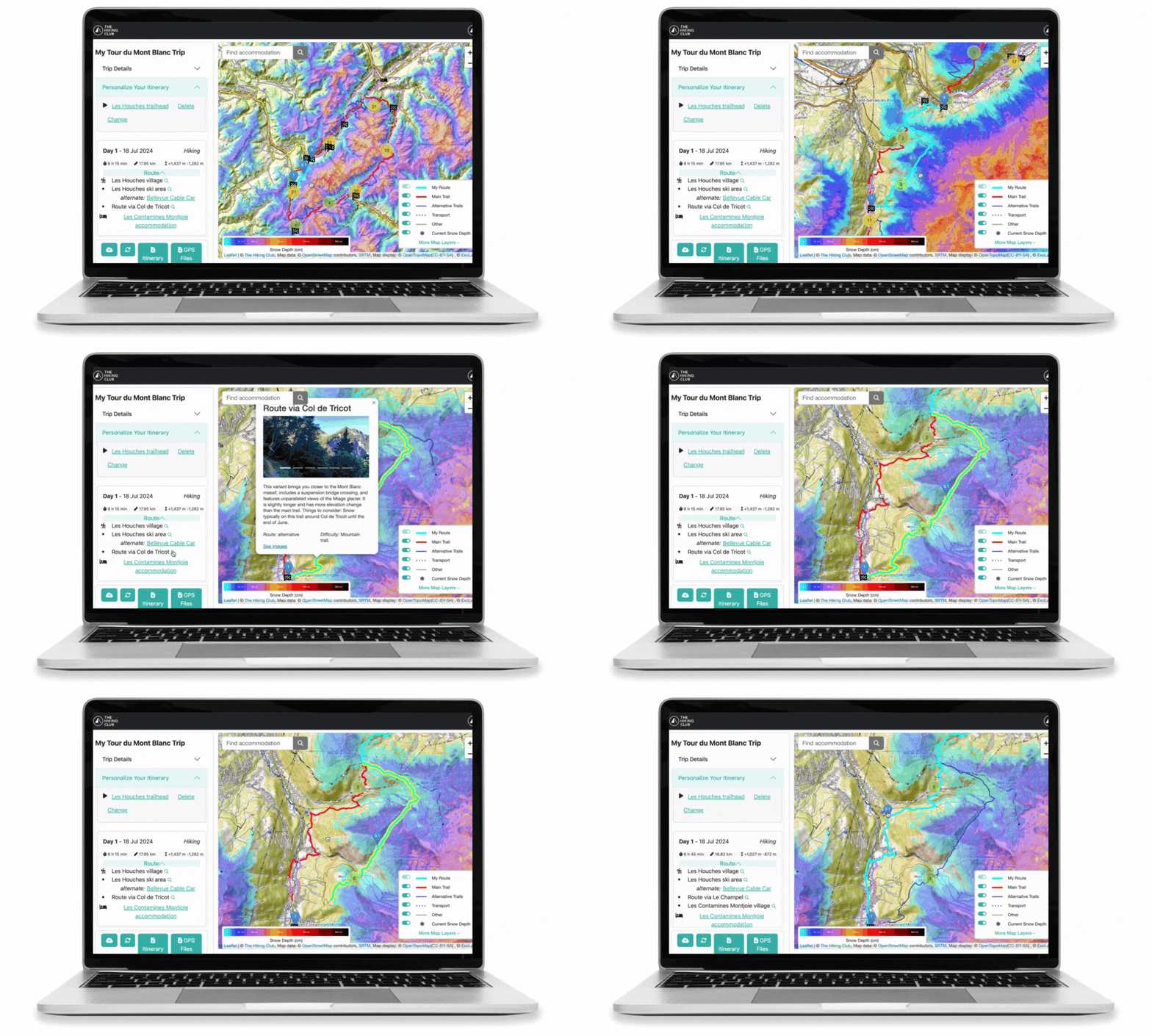
5. Take note of shortcuts. While we only made use of a few of the shortcuts available, I did take note of the various public transportation, cable cars, and shortcuts ahead of time, so if we had bad weather, were short on time, or someone wasn’t feeling well, we had options. We planned to take the Bellevue Cable Car on the first day and were happy we did so – especially since we did the Col de Tricot variant. Taking the Delone Cable Car was a huge plus for my daughter as we headed down to Courmayeur for a rest day. I will say that this is where customized maps from The Hiking Club combined with the Organic Maps app were super useful – you can see public transportation options – but also alternative routes. On our last two days on the trail, less-than-ideal weather had us adjusting our routes on the fly, and I was so thankful that we could see what options were available to us when we needed to make decisions in the moment.  

6. Staying in accommodations. We were fortunate enough to book private rooms or 4-person dorms for all nights except two on the trail. This worked well for our family, as it allowed the kids to be a little more comfortable after a long day of hiking. We still got the mountain hut experience with the shared meals and (often) shared restrooms. Our two evenings in shared dorm rooms were fine – thankfully we had lovely roommates both times (6-person dorm rooms). But the nice thing about hut-to-hut hiking is that even if you don’t love the place you’re staying at one evening, it is only for one night and you’ll have a new place to look forward to the next night.  

Reflections  

While hiking the TMB is not for everyone, with the proper preparation and a willing attitude, it is possible to complete the trek (or part of the trail) with children. I loved watching my kids grow on the trail. They adapted to trail conditions, problem-solved, tried new food, and met people from all over the world – all while hiking more than 100 miles over 11 days. Was there complaining? Yes. Were there tears? Yes. Were there sore legs? Yes. But there were also memories made, relationships formed, and fears conquered – it was the trip of a lifetime. All of us learned to be more resilient; we pushed through pain and fatigue and learned each day that we could do hard things.  

Upon returning home, we returned to our familiar trails of the AT and started reminiscing about the Alps... My teen daughter started talking about which sections of the TMB she would want to repeat when we return in a few years – as well as what other trails she would like to explore in the Alps. 

Time to start planning our next adventure!


Follow Meggan on her Instagram for more family hiking content: @mountainsarecalling_wemustgo

Should I get an Alpine Club membership for the Walker's Haute Route

The official Walker’s Haute Route travels through France and Switzerland.

If you are a member of one of the respective alpine clubs, you get discount on accommodation at their mountain huts. Here are the details on each alpine club membership:

FRENCH ALPINE CLUB MEMBERSHIP

The French Alpine Club has a membership program that provides discounts to their mountain huts. Membership is about 100 - 120€ and is open to non-French citizens. For full details click here. The huts along the Walker’s Haute Route that are owned by the French Alpine Club include: Albert 1er (Premier).

Refuge Albert Premier

SWISS ALPINE CLUB MEMBERSHIP

The Swiss Alpine Club has a membership program that provides discounts to their mountain huts. Membership is from 80 CHF and is open to non-Swiss citizens. For full details click here. The huts along the Walker’s Haute Route that are owned by the Swiss Alpine Club include: Cabane du Mont Fort, Cabane des Dix, Cabane de Moiry, Turtmannhutte.

View from Cabane de Moiry


plan and navigate your ultimate WALKER’S HAUTE ROUTE adventure

Should I get an Alpine Club membership for the Tour du Mont Blanc?

The Tour du Mont Blanc travels through France, Switzerland and Italy.

If you are a member of one of the respective alpine clubs, you get discount on accommodation at their mountain huts. Unless you plan to stay exclusively in alpine club mountain huts, it is not usually worthwhile getting membership only for the hike. Here are the details on each alpine club membership:


FRENCH ALPINE CLUB MEMBERSHIP

The French Alpine Club has a membership program that provides discounts to their mountain huts. Membership is about 100 - 120€ and is open to non-French citizens. For full details click here. The huts along the Tour du Mont Blanc that are owned by the French Alpine Club include Albert Premier (1er), Refuge Croix du Bonhomme and Chalet Des Contamines.

Refuge Croix du Bonhomme

SWISS ALPINE CLUB MEMBERSHIP

The Swiss Alpine Club has a membership program that provides discounts to their mountain huts. Membership is from 80 CHF and is open to non-Swiss citizens. For full details click here. None of the huts along the Tour du Mont Blanc are owned by the Swiss Alpine Club.

ITALIAN ALPINE CLUB MEMBERSHIP

Rifugio Elisabetta

The Italian Alpine Club has a membership program that provides discounts to their mountain huts. Membership is from 45€ and is open to non-Italian citizens. For full details click here. The huts along the Tour du Mont Blanc that are owned by the Italian Alpine Club are Rifugio Elisabetta and Rifugio Monte Bianco (in Val Veny off the TMB trail)


plan and navigate your ultimate Tour du Mont Blanc adventure

Comparing the Tour du Mont Blanc and Alta Via 1: Which is Right for You?

Comparing the Tour du Mont Blanc and Alta Via 1: Which is Right for You?

When planning a European trekking adventure, two routes often stand out for their breathtaking scenery, sense of adventure, and challenge: the Tour du Mont Blanc (TMB) and the Alta Via 1 (AV1) in the Dolomites. While both are famous and stunning in their own right, they offer different experiences in terms of length, difficulty, crowds, terrain, and scenery. So, which is the better fit for your next trek?

The Hiking Club partners with ExoLabs to provide snow data from space

How AI, satellites, and Swiss innovation will keep thousands of self-guided hikers safe in the Alps this summer.

How much snow is still on the trail, and where exactly is it? The answers to these important questions are required for early-season hikers to assess the risk of their planned route and determine if any changes are necessary. Uncertainty around snow conditions can be costly, leading to both re-planning and risk-taking, negatively impacting what should otherwise be the incredible experience of hiking in the Alps.

For the past 5 years, The Hiking Club has been undertaking the task of providing the latest trail conditions through a human-led approach, a “Break The Trail” update from The Hiking Club team, and then ongoing daily trail reports from trail ambassadors from The Hiking Club community. Despite these programs giving self-guided hikers a comprehensive view of where the snow is on the trail at a point in time, these updates can quickly become obsolete. The Hiking Club team has been searching for a way to provide more regular snow updates in a format that is targeted and actionable.

Thanks to The Hiking Club’s new partnership with ExoLabs, we’ve found it. The Hiking Club has integrated ExoLabs’ estimated current snow depth and 48-hour new snow forecast layers into the map in their trip planning app. Snow uncertainty will be a thing of the past on famous multi-day trails in the Alps, like the Tour du Mont Blanc, Walker’s Haute Route, and Alta Via 1 Dolomites.

The estimated current snow depth will be critical for hikers in June and July, to ensure they have the most up-to-date information on where the snow is located and its expected depth along the trails. The 48-hour new snow forecast will be valuable for hikers throughout the season as it will indicate where and how much snow is expected to fall along the trails for informed decisions.

Estimated current snow depth and 48-hour new snow forecast layers now available in The Hiking Club trip planning app.

These legendary trails attract self-guided adventurers from around the world who are often experienced in mountain hiking but have little or no experience in the Alps. Without having local knowledge over multiple seasons, applying general snow reports of an area to a hiking route is hard. Tour companies often use local guides to check trails and translate these reports for their clientele, but self-guided hikers who have planned their own trips don’t have access to this resource.

“It has never been easier for self-guided hikers to plan their own trips in the Alps, and by adding ExoLabs snow layers to our app, we will also help make the early season hiking experience safer than it has ever been before.”
— Brendan Jones, Co-Founder of The Hiking Club

ExoLabs has developed an innovative solution to show the expected current snow cover and snow depth on a map. Their truly novel approach feeds daily satellite imagery and weather station data, (including field readings and snow analysis), through complex models driven by modern machine-learning techniques to produce a snow distribution over the topography of the Alps and other mountain ranges worldwide. This snow projection has a 20-meter resolution and is updated daily.

The snow depth layer was validated with over 2 million data points from the Swiss Alps and achieved an average error of just 0.36 meters of snow depth. Given the high variability of snow depth distributions and the spatial resolution of 20 meters, this is considered a very accurate result. It will be a marked improvement on the single high-level snow report for a region that has previously been available to the hiking community.

Make informed route decisions based on estimated current snow depth data in The Hiking Club’s trip planning app.

The new snow layers are now available in The Hiking Club planning app, part of release V1.11, and will be the basis for our 2024 trail updates program during the early hiking season.


About ExoLabs: Linked to the University of Zurich, Exolabs specializes in environmental monitoring. Using satellite data as well as weather and climate models, and modern machine learning techniques, ExoLabs is able to gain a comprehensive insight into the condition of our environment. This valuable information is then presented in a user-friendly format in order to facilitate informed and sustainable decision-making.

About The Hiking Club: The Hiking Club allows adventures to easily plan and safely navigate legendary trails in the Alps. With a trip planning app, GPS mobile maps, and up-to-date trail information, The Hiking Club has everything a self-guided hiker and trail runner needs for their inspiring and challenging journey.

2024 Training Diary: First 6 weeks

Off season activities: I enjoyed competing in a local triathlon during the off-season. Michael (L) and Brendan (R).

In October each year, I transition to my hiking off-season exercise regime, which involves very little forward planning, structure, or activity tracking. This is in stark contrast to my action-packed hiking season in the Alps, which is all about detailed daily planning and capturing content. While my off-season approach to exercise usually adds a couple of inches to the waistline, it’s a great way to unwind and give my body a break.

At the end of February, my approach to exercise changes gear as I move from free-wheeling to a formal training plan in preparation for the upcoming hiking season in the Alps! I started following a structured plan in the lead-up to last season and found it to be a game-changer given my old approach was no longer working for me. You can read more about my training environment and change in approach here.

As noted in our first training diary blog post, Susan and I are planning to complete 8 legendary hikes to share updates for our existing trails and capture content for new trails we’ll be adding to The Hiking Club platform. My training plan for this year has been designed around completing the Tour du Mont Blanc in 5 days. All the trails I do after this will have similar size days, so provided I stay healthy and focus on recovery and maintaining my fitness between hikes, this is the right plan for me.

Training plans for hiking in the Alps: The Hiking Club has an educational webinar and template to help hikers create their own training plan.

I created my own training plan by using our template last year to prepare for my ‘Break the Trail’ hike. Given I was able to achieve all my hiking goals in 2023, I’m using our training program again for my 2024 preparation! Below, you will find a few notes and a self-determined grade for each of the training components over the first 6 weeks of my 2024 training plan.

Starting point

I chose to immediately build on my average weekly step count from the weeks leading up to the start of my training program rather than reducing my step starting point by taking credit for introducing strength sessions. I felt confident doing this wouldn’t overload my training, as I had already taken a conservative estimate on my current weekly step count and was already doing a lot of cardio training, which would be reduced. By using this approach, based on my average weekly steps before starting the program, our training framework calculated that I needed a 12-week training plan to reach the goal of being ready for a 5-day Tour du Mont Blanc.

Strength sessions

Mark: 5/10

Despite having the best intentions to complete these, I’ve only done half of the sessions so far. Because of this, I haven’t done any ‘deload’ weeks as I’m already having these rests by not doing all the sessions. I’m disappointed by this, given I know how important and beneficial they are! I always plan to do them in the evening after the kids have gone to bed. However, I’m not very motivated to exercise at this time, especially when it’s the second workout of the day, so I needed to change it up for the next 6 weeks!

ENDURANCE TRAINING - SHORT CARDIO

Mark: 10/10

Bike riding: I love understanding how to take credit for different activities with the conversion table in our training plan. Pat (L) and Brendan (R)

I’m enjoying a variety of activities for my short cardio, including swimming, running, stair-stepping machines, and bike riding. I haven’t had any problems achieving my short cardio goal, and I regularly go well over the weekly target, given that it’s normal for me to do a lot of cardio each week.


ENDURANCE TRAINING - STEPS

Mark: 8/10

Training in Australia: A steps endurance session quickly turns into a short cardio session when there is a snake on the trail!

I’ve had a lot of variability in my step count each week. In total, I’ve done 33,000 more steps than I needed to over the first 6 weeks of the program, however, I’ve gone way over the weekly goal in half the weeks and then between 2,000-7,500 steps under on the other half. Each week, I’m pleased to have completed a longer endurance session on Saturday and will focus on trying to get closer to the step goal each week.

One thing I realised is that my stride length is nearly 50% higher when I run than when I walk. Therefore, I’m doing a distance-based step conversion for any hiking/running where my stride length is more than a walk, so they can be applied to the overall step count in the same step unit measurement (which is my average step/stride walking length).

REST

Mark: 8/10

One planned rest day and occasionally I’ve also had another unplanned day when I couldn’t find the time for training. Rather than changing my plan to train on my next planned rest day, I’ve opted to ‘catch up’ on the endurance training.


It’s great to be back training with purpose again. Based on how I’m feeling halfway through my 3-month program, I’m confident that I’ll have the endurance and strength to thrive on my 2024 Break The Trail hike. If you want to use our training program to create your own plan, check out the bundle below.

2026 Training Bundle: How to train for a multi-day hike in the Alps
Sale Price: €29.00 Original Price: €48.00

*Promotion - Get the training bundle for €29 (usually €48)*

Training for a multi-day hike in the Alps is not easy when you live at sea level. It can be hard to know how best to prepare your body for big elevations, mountain conditions, and back-to-back days on the trail.

Our 2026 training bundle is designed for hikers preparing for a multi-day hike in the Alps, such as Tour du Mont Blanc, Walker’s Haute Route, Alta Via 1 Dolomites, Alta Via 2 Dolomites, Tour of Monte Rosa, Bernese Oberland Traverse, Tour des Combins and West Highland Way.

It’s for those that are looking to improve their hiking performance through a combination of step endurance, cardio and strength activities.

The 2026 training bundles includes 2 of our popular training materials:

  1. 3 Month Training Program

  2. Webinar: How to train for your multi-day hike in the Alps

Designed in partnership with Stacey Hardin, Founder of Pique to Peak, Doctor of Physical Therapy and Athletic trainer, our 2026 training bundle prepares your body for hiking the Alps.

It includes:

  • Recorded 90 minute webinar: How to train for your multi-day hike in the Alps

  • Training program PDF: Learn about our Alps specific methodology

  • 3 Month training template: Create your training program based on your current fitness and specific hike stats, including distance and number of days on the trail. Schedule weekly workouts, track your steps and see your workout history.

  • Library of workout videos: Watch demonstrations of hiking specific strength exercises

The training program is based on 3 core activities:

  1. Step endurance

  2. Short cardio (i.e 20-30 min run, bike, swim, incline walking)

  3. Strength exercises (i.e 30-40 min exercises such as squats, planks, push-ups)

Author: Brendan Jones, The Hiking Club
A pizza-making, craft beer-loving, peanut butter connoisseur that has been exploring the great outdoors since completing the Duke of Edinburgh Award in high school. He started The Hiking Club to democratise hiking and the benefits that come from spending time in nature. You can read more about Brendan and the team here.

How much does it cost to hike the Bernese Oberland in Switzerland?

How much does it cost to hike the Bernese Oberland in Switzerland?

It costs 500 Swiss Francs to plan your own 6-day hike in Bernese Oberland, Switzerland.

This cost will vary depending on the number of days on the trail, and your accommodation, food, and transport preferences. So, how do you calculate how much it will cost for your trip? Here are a few sample itineraries using actual 2024 costs to help you out!

Europaweg Trail: Complete guide

Europaweg Trail: Complete guide

The Europaweg Trail between Grächen and Zermatt is one of the most famous two-day hikes in the Alps, as well as forming part of the Walker’s Haute Route and Tour of Monte Rosa. In the past few years, there has been some confusion about where exactly the Europaweg trail goes, due to the original route still appearing on some outdated maps, apps and guidebooks. In this updated post, I share details about the Europaweg trail, clarify where the route goes and share a brief history of trail changes in recent years.

Hiking Poles: Essential Gear for Long-Distance Hiking in the Alps

Hiking Poles: Essential Gear for Long-Distance Hiking in the Alps

Hiking poles are essential gear for long-distance hiking in the Alps. They provide a number of physical benefits that can help you hike more comfortably and efficiently. Read our blog post to learn more about why to use hiking poles, how to use them, where to buy them and how to travel with them on the aeroplane.

Tour of Monte Rosa: The Alternate Routes

Tour of Monte Rosa: The Alternate Routes

The standard Tour of Monte Rosa trail is 167 km / 104 mi. But did you realise that there are lots of exciting alternate routes you can incorporate into your hike to make it even more epic? Or alternate routes that allow you to skip some of the more difficult and challenging sections. Take a read through our list of top alternate routes for the Tour of Monte Rosa to make sure you are choosing the best routes to suit your ideal hike!

Tour of Monte Rosa: The Main Trail

Tour of Monte Rosa: The Main Trail

The “main” Tour of Monte Rosa trail is 167 km / 104 mi. It passes through major villages such as Saas Fee and Zermatt. It crosses the Theodul glacier. It follows 2 of the most spectacular balcony trails in the Alps: Europaweg and Hohenweg. It truly is one of the legendary multi-day hikes in the Alps. Read our detailed blog post which takes a “walk” through all the different sections of the main Tour of Monte Rosa trail, including images, descriptions and trail stats.