

Compare 4, 5 and 6-day Tour du Mont Blanc trail-running itineraries. Explore daily distance, ascent, accommodation and possible luggage transfers.

It costs €826 to plan your own 10-day hike of the Tour du Mont Blanc. This amount comes from our new cost calculator for the Tour du Mont Blanc, which uses over 300 actual customer itineraries and 2023 costs from nearly 100 accommodation and service providers along the trail.
the calculator is for self-guided hikers to estimate how much it will cost them to organise their own hike of the Tour du Mont Blanc based on their preferences. Give it a try!
So you’re interested in hiking the Haute Route from Chamonix to Zermatt but want to camp, instead of staying huts, hotels or B&Bs each night? Great choice! Although the idea of spending each night under the stars is an idyllic option, you need to be aware of where you can actually camp along the Haute Route, as there are very strict rules put in place by the National Parks and local governments.
Over the past few years, we’ve gathered the latest information on where you can wild camp, campgrounds with facilities and mountain huts that allow you to camp nearby. About 20% of our customers use our platform to plan and navigate their camping adventure along the Haute Route. Read on to learn about the various camping options, the cost estimates for camping and other useful tips to help you prepare for camping the Walker’s Haute Route.
How much it costs to hike the Walker’s Haute Route is one of the most common questions I’m asked. Armed with my accounting background and mission to make every hikers self-guided dreams come true, I’ve dug deep into the numbers across all the different accommodation types, food and services available to provide firm guidance on what it costs to hike the Walker’s Haute Route.
The Bear Trek is located in the Bernese Oberland, Switzerland and is part of the Via Alpina 1 hike that includes 20 stages from Lichtenstein and continues to Montreux, Switzerland. Read Cindy and Bob’s trip report documenting stages 10 - 15 from Meiringen to Lenk, Switzerland. Spoiler: No bears were seen on this hike!
While many of the wonderful Tour du Mont Blanc refuges will feature on your ideal self-guided hiking itinerary, what do you do if they have no availability when you go to book your own trip? In this blog post, I’m going to share accommodation booking tips and my top 4 booking tricks for finding accommodation that will keep your trip alive.
It costs €826 to plan your own 10-day hike of the Tour du Mont Blanc. This amount comes from our new cost calculator for the Tour du Mont Blanc, which uses over 300 actual customer itineraries and 2023 costs from nearly 100 accommodation and service providers along the trail.
the calculator is for self-guided hikers to estimate how much it will cost them to organise their own hike of the Tour du Mont Blanc based on their preferences. Give it a try!
Get personalised email alerts when a verified trail closure, warning, detour or transport disruption affects your planned multi-day hiking itinerary on popular trails such Tour du Mont Blanc, Alta Via 1, Alta Via 2, West Highland Way, Walker’s Haute Route, Tour des Combins, Tour of Monte Rosa, Bernese Oberland.
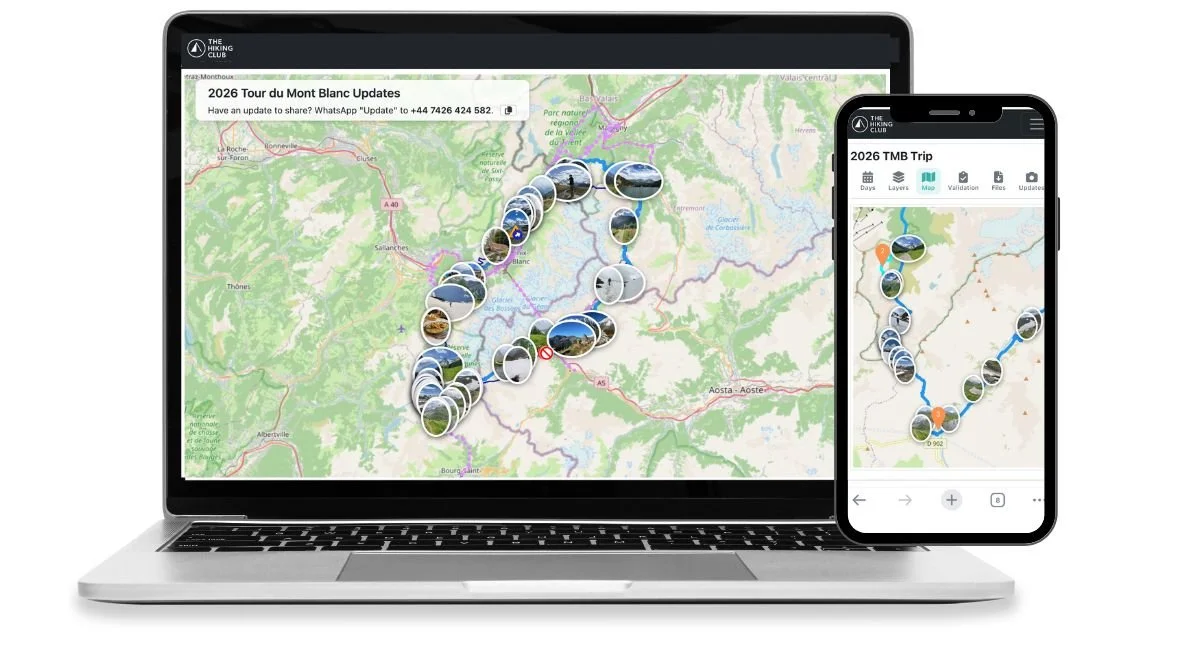
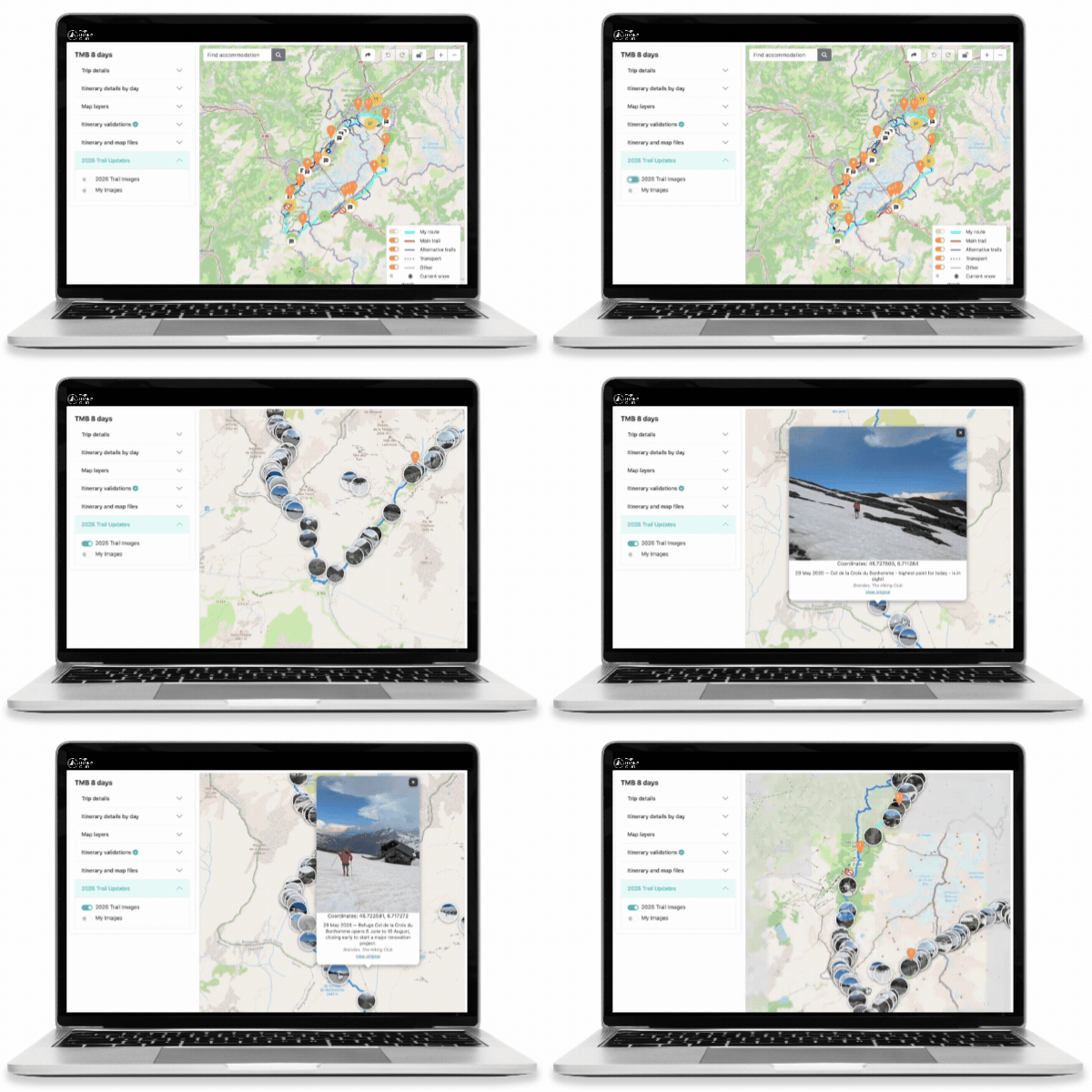
Today, we’re launching the first version of our 2026 Trail Updates Map — a new way to explore the latest trail conditions, closures and mountain updates directly on the trail map inside The Hiking Club platform.
For years, hikers have relied on scattered social media posts, group chats and outdated forum threads to understand what conditions are really like on the trail. The problem? Those updates rarely include context. A beautiful photo of snow coverage or a washed-out bridge only helps if you know exactly where it was taken — and when.
The 2026 Trail Updates Map changes that.
Instead of endlessly scrolling through feeds hoping to find relevant information, you can now see real-time trail updates directly on the map itself.
Best of all, the 2026 Trail Updates Map is completely free to access inside The Hiking Club platform. Simply create a free account to start exploring the latest trail photos, closures and mountain updates across the network.
The 2026 Trail Updates Map brings together the latest trail photos, route and transport closures into a single map-based experience, helping you understand what’s happening across the trail network before you head out this season.
With the 2026 Trail Updates Map, you will be able to:
Explore the latest uploaded trail photos directly on the map
Search updates by specific locations such as mountain passes or sections at higher elevation
View trail closures and warnings in context
See transport disruptions including gondola and chairlift closures
Scroll back through previous uploads to understand how conditions change throughout the 2026 season
Share important updates and images with fellow hikers
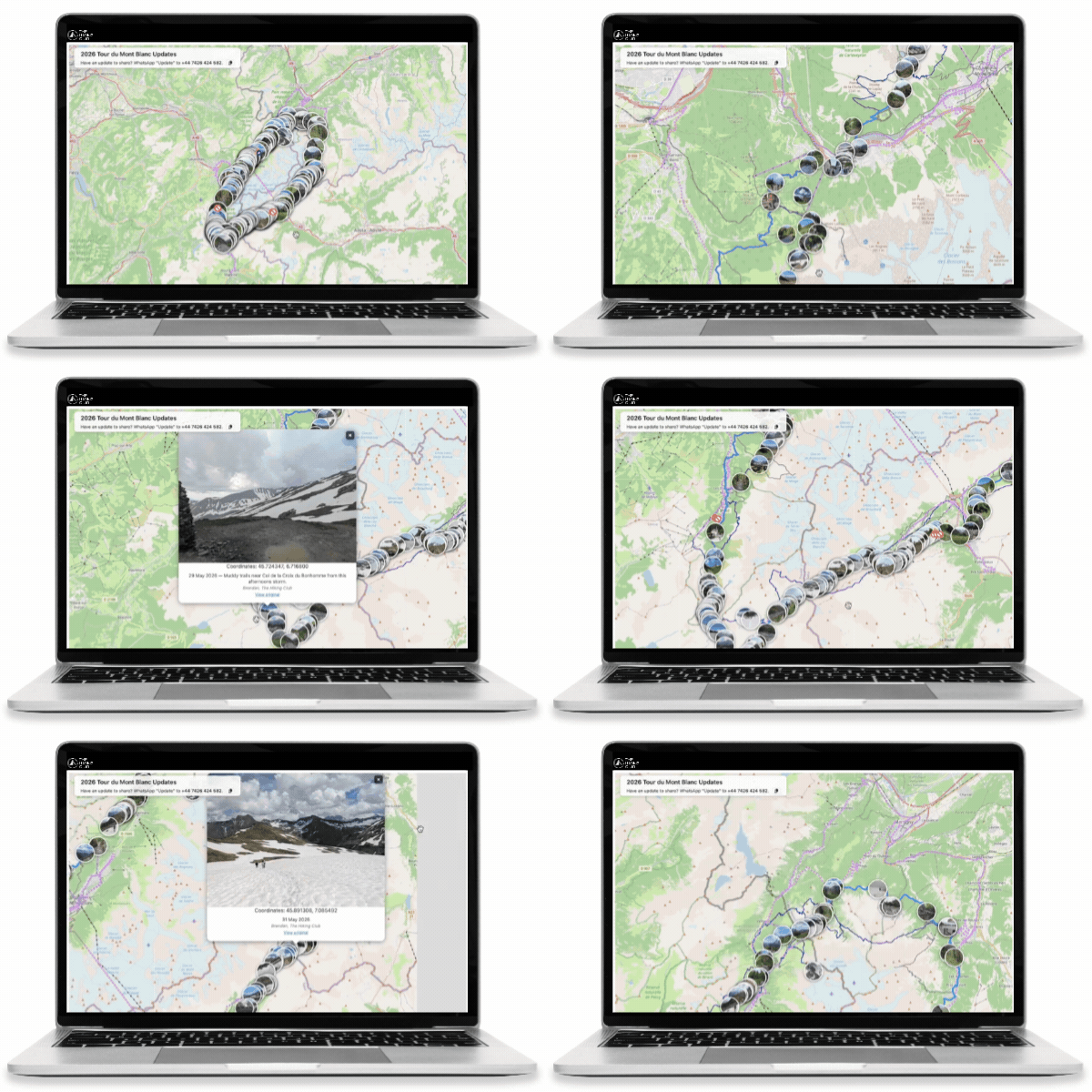
First updates loaded onto the 2026 Trail Updates map on May 29th, 2026 from the Tour du Mont Blanc.
For paid customers of The Hiking Club, our new Trail Updates feature becomes even more powerful.
Instead of viewing updates only on the general trail map, paid members can see trail conditions, photos, closures and transport alerts directly alongside their planned itinerary route. This makes it easier to understand exactly what’s happening on the sections you’ll be hiking in the days ahead — latest snow conditions on a mountain pass, a trail detour, or a gondola closure affecting your planned route.
By combining live trail updates with your personalised itinerary, The Hiking Club helps you stay informed and make smarter decisions before and during your hike.
The 2026 Trail Updates Map is powered by people on the ground — the hikers out there walking them every day.
Each June, The Hiking Club team heads to the Alps for our annual “Break The Trail” hikes, capturing the first comprehensive overview of trail updates, snow conditions and route information.
We then pass the baton to our incredible community of Trail Ambassadors, who will continue sharing daily trail photos, trip reports and insights from the trail. Their updates help hikers embarking after them feel safer, more informed and a clearer picture of what’s happening across the mountains.
We hope that the 2026 Trail Updates Map becomes a community-powered view of the hiking season as it unfolds.
Want to help fellow hikers this season? We’re always looking for passionate hikers to join our ambassador community and contribute trail updates from across the network. Learn more here.
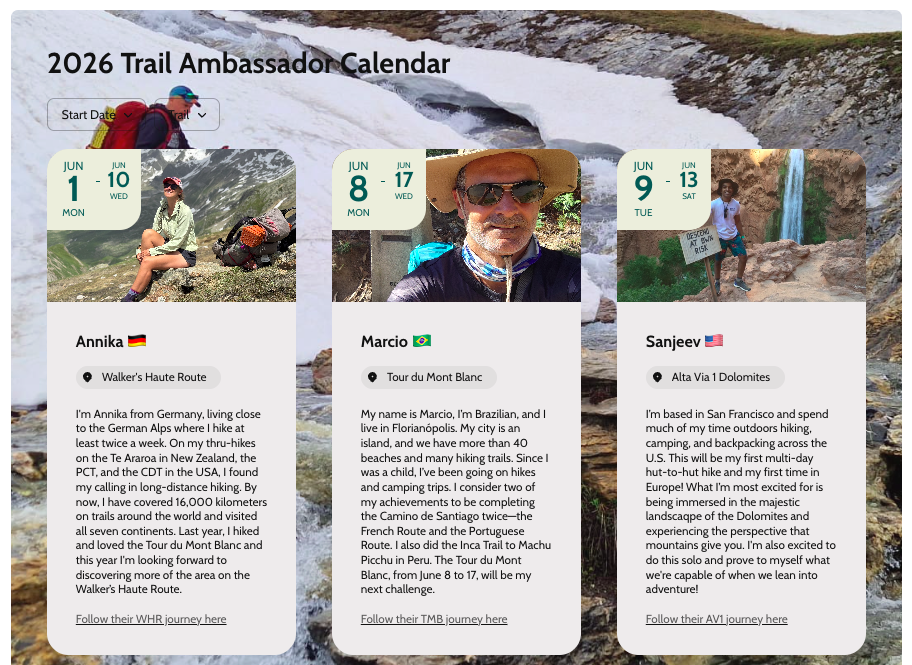
Our Trail Ambassadors kick off their trail updates on June 1st and continue through to the end of September.
The 2026 Trail Updates Map is launching as an evolving feature for the 2026 hiking season, and we’ll continue improving it as more hikers begin using it on the trail.
Feedback from our community will play a huge role in shaping what comes next.
If you spot something that could be improved, have ideas for new features, or want to tell us what’s working well, we’d love to hear from you. The goal of the Trail Updates Map is simple: make trail information more useful, more accessible and more reliable for everyone heading into the mountains. Contact us at: info@thehiking.club to share your feedback.
The 2026 Trail Updates Map is available free inside The Hiking Club platform.
Dedicated 2026 Trail Updates Maps will be available for:
Tour du Mont Blanc
Walker’s Haute Route
Tour of Monte Rosa
Alta Via 1 Dolomites
Alta Via 2 Dolomites
Bernese Oberland
Tour des Combins
West Highland Way
Don’t yet have an account? Create your free account to explore the latest trail conditions, community updates, transport closures and “live from the trail” photos throughout the 2026 hiking season.
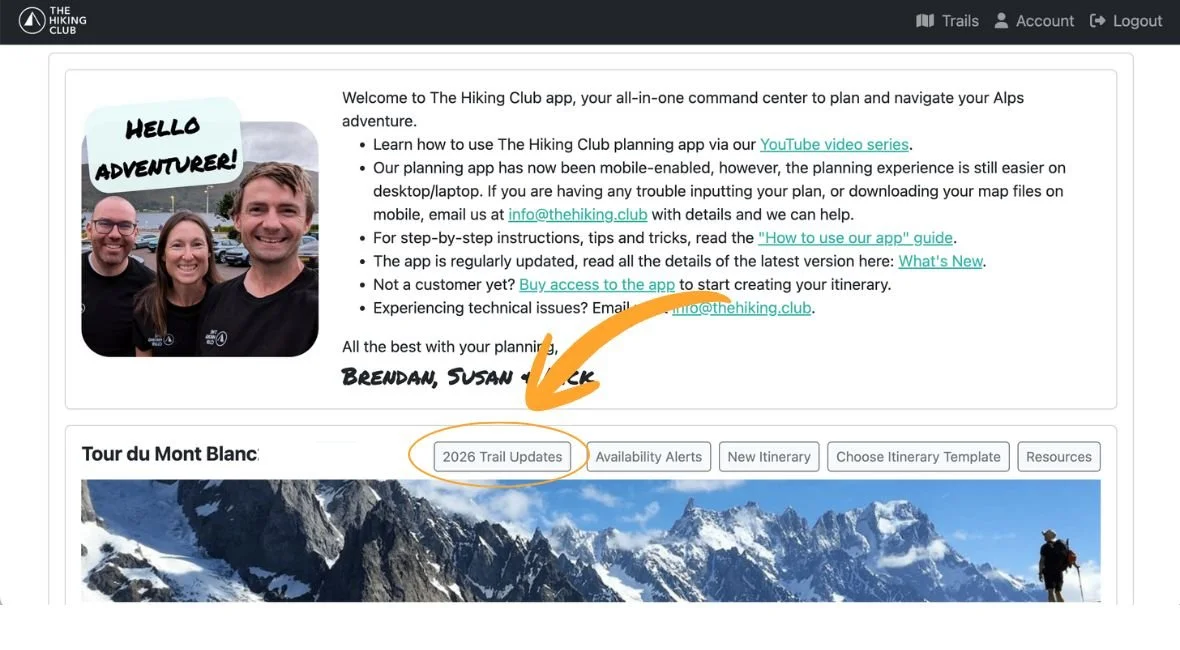
Create a free account at www.app.thehiking.club to view the 2026 Trail Updates map.
Essential gear for Via Ferrata: your complete gear list. Via Ferrata is an exhilarating way to experience the mountains, combining hiking with the thrill of climbing. To make sure you're well-prepared, having the right gear is crucial for safety and enjoyment. Here’s a short list of essentials you’ll need for a successful Via Ferrata adventure:
Sam McGrady and Steve Smedley live in Matlock, Derbyshire, and are seasoned multi-day trekkers across Europe and the UK. Focused on travelling as light as possible (no camping), they undertake at least one long-ish trek each summer using mountain huts and small villages for accommodation. Previous trips have included Walkers’ Haute Route, GR11 (Spanish Pyrenees traverse), Tour de Mont Blanc, Tour de Monte Rosa and AV1 (Dolomites).

Summer 2024’s adventure took Sam and Steve back to Switzerland to undertake the Tour of Jungfrau Region (JFR) – which whilst following the ‘official’ route most of the time, they made their own with variants, side trips and some extra days thrown in. It should also be noted that Sam and Steve are vegetarians, so references to food should be taken in that context and explains the obsession with rostis on this trip!
13 hiking days
1 rest day (at Kleine Scheidegg)
Total distance – approximately 196 km (122 miles)
Total ascent/descent – 12,390m (40,650 ft) gain/loss
Start/finish – Wilderswil (Interlaken), Switzerland
Sam and Steve’s 13 day itinerary designed in The Hiking Club planning app.
It’s very popular and busy – not so much the trail itself but there are lots of very accessible points most days via an excellent integrated public transport system (trains, cable cars, ski lifts, buses) resulting in hoards of ‘tourists’. It’s not a trek for getting away from it all.
The walking is straight forward, nothing technical. Likewise route finding simply isn’t an issue. The amount and variety of accommodation options mean you can make your days as long or short as you want. Don’t feel the need to stick to the traditional route and stages, busk around the template.
It is an area of outstanding and amazing scenery – Eiger, Monch and Jungfrau are omnipresent and undoubtedly the star attraction, but this should not diminish the contribution of many other outstanding mountains that will be familiar to alpinists but not the average hiker or tourist. There are also numerous glaciers to see and the landscape is varied and interesting. When we went the alpine flowers were abundant and a joy to see. Take your time, stop and stare.
Having flown to Geneva and then taken a train to Interlaken the previous day, we started our TJR with a great breakfast in the Alphorn hotel in Interlaken, including fresh fruit and hard boiled eggs. We walked across the Ruegen to Wilderswil (a lovely village in contrast to the somewhat tourist-hammered Interlaken) then set off walking uphill through forest to the cog railway station at Breitlauenen, which has a fab little café.
As the onward path to Schynige Platte was closed due to rockfall we took the cog railway for the remaining relatively short distance – which was fun! After checking in to the somewhat swanky Berghotel Schynige Platte (the only show in town) the cloud was down and the rain had started. As we’d reached our destination for the day this wasn’t a problem and we had a decent meal in the hotel looking out at cloud and rain where one of the best views in Switzerland should have been!

Panorama Schynige Platte to Grosse Scheidegg
We woke up to completely clear skies, sun and amazing views of the full mountain range opposite – Eiger, Monch and Jungfrau, which would accompany us on much of this trek. After a great breakfast of eggs, cheese and local honeycomb, we packed up and set off, taking our time for the first few miles to stare and take photos.
Spring flowers were abundant. The weather was sunny but with a fresh cool wind. The route took us across myriad snowfields which really slowed us down. However, we had absolutely amazing views all the way – Eiger, Monch and Jungfrau to the right and Brienzsee below us to the left - and even saw an eagle near the Faulhorn (today’s high point).
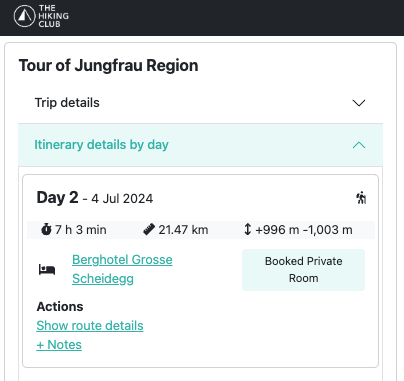
Day 2 hiking stats for Sam and Steve’s itinerary, as displayed in The Hiking Club planning app.

Views all the way – Eiger, Monch and Jungfrau
The route wasn’t too busy until we reached the Bachsee lakes, which were teeming with visitors who had come up on the gondola to First. We were happy to leave the selfie-fest behind at First (the official end of today’s stage but not our end point) and took a solitary walk to Grosse Scheidegg in increasing cloud. What an amazing spot - right underneath the Wetterhorn.
Again, the Berghotel Grosse Scheidegg is the only accommodation here, and we had a cosy double room. The food was good: salad plus rosti with fried vegetables. After a long day we headed for an early night.

Wetterhorn above Grosse Scheidegg
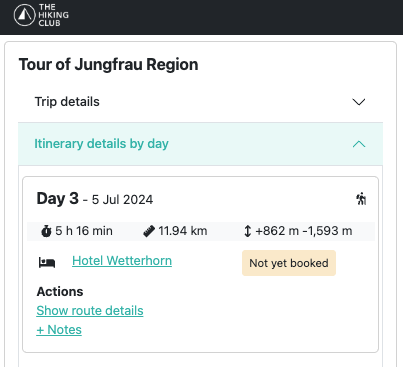
Day 3 hiking stats for Sam and Steve’s itinerary, as displayed in The Hiking Club planning app.
After a fairly basic breakfast, we headed off around 9.30am down the path towards Grindelwald. After about 30 minutes we went left on a TJR variant towards the Gleckstein Hut. The route comprised a somewhat vertiginous path a lot of the way with chains and cables – but all perfectly manageable. Up, up and up we went. Above us towered the Oberer Grindelwald Gletscher and beyond it the Schreckhorn; we also saw chamois, ravens and choughs.

View of glacier from Gleckstein Hut
All day we had full, hot sun, because whilst the substantive route is roughly east/west, the variant to the hut is north/south. The hut was in an amazing spot, and we drank coffee whilst watching ice falls from glacier – we could have stayed all afternoon!
After a slice of delicious nusskuchen, we headed back down the same way we came, which was hard on ageing knees and our walking poles were required. We stopped for a snack at possibly the most exposed bench in the valley before re-crossing a short snowfield then heading across meadows to Hotel Wetterhorn near Grindelwald.
We sat outside with a beer and looked up at the knife edge Mittellegi ridge of the Eiger right above us. Our evening meal comprised another rosti (this time with egg and cheese) and a savoury vegetable strudel. A wonderful spot to end the day.

Most exposed bench in Grindelwald valley!
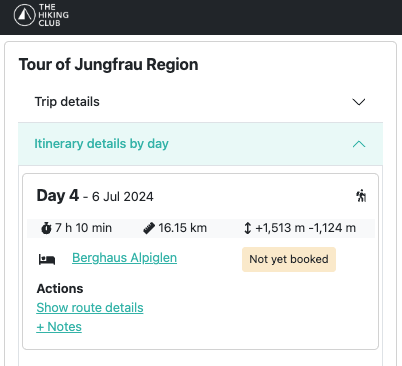
Day 4 hiking stats for Sam and Steve’s itinerary, as displayed in The Hiking Club planning app.
After a decent breakfast of fresh fruit and muesli, we set off around 9am in the dry, although rain was forecast for later in the day. As it happened we spent most of the day in woods but we did get some short lived heavy rain in the afternoon, necessitating an outing of our waterproof ponchos!
Again, we decided to make a side trip off the TJR up and back to Berggasthaus Barregg to see another glacier – not such a big climb but an equally great spot where we had coffee, and a good chat with the hut guardian about how the previous month’s awful wet weather had taken a real toll on trade.
After a long descent back to the valley bottom, we climbed up all afternoon, eventually making it to Alpiglen. The route was excellent, right underneath the Eiger and we saw several chamois. Unfortunately the cloud was down most of the time so we couldn’t make the most of the location. However, on the short descent to Alpiglen itself the cloud broke up enough for us to have views right across the valley back to Schynige Platte. Once again we were in the only available accommodation in the hamlet.
In the evening we got chatting to some young American hikers who were doing some of the TJR but in the opposite direction; for a future trip they usefully put us onto the White Mountains in New Hampshire where they have a hut system similar to Europe.

Snowfield and sheep on way to Alpiglen
Hotel Alpiglen provided a good breakfast with fruit, yogurt, muesli, bread and cheese; we strung it out due to 100% cloud cover and light rain, and so didn’t leave till gone 10am. Climbing up we crossed numerous torrents and small snow fields, and saw two alpine salamanders which seemed unaware of Darwinian evolutionary theory and slowly meandered around our feet.
The cloud lifted a little from time to time but it was very frustrating that we were right underneath the Eiger north wall and couldn’t see it! The rain stopped around midday but we were still plagued with poor visibility. We stopped at Eigergletscher (gondola and train station) for coffee and Rahmschnitte cake (a local speciality, great for morale but bad for the abs!).
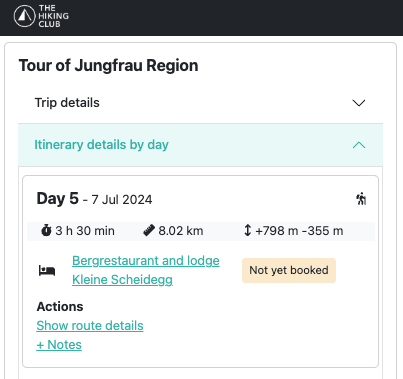
Day 5 hiking stats for Sam and Steve’s itinerary, as displayed in The Hiking Club planning app.
From here it was an easy half hour down to Kleine Scheidegg, conditions were cool and cloudy. After checking into our accommodation at Restaurant Grindelwaldblick we did some laundry and booked tickets for the Jungfraujoch for tomorrow – our first rest day. The cloud was still down so we had yet to see the infamous Eiger North Face properly. To celebrate making it this far we ordered a cheese fondue which was delicious! It is worth noting that when the cloud clears, this location has one of the best views of Eiger, Monch and Jungfrau due it standing half a kilometre or so back from Kleine Scheidegg itself.

Eiger North Face emerges from cloud
We got up at 7am to try to get the early bird train to Jungfraujoch (the amazing railway which goes through the middle of the Eiger and pops out at the saddle between Monch and Jungfrau, where there is a huge visitor centre). There was an enormous number of tourists, and we had to queue and so didn’t get the first train; it’s definitely worth paying the extra to reserve a seat in advance. In fact the whole thing was unbelievably busy all day. However, it was an exciting train journey up through the tunnel, and we headed straight out into the snow and walked to the Monchsjochhutte for coffee and plum tart. This was our only use of our micro spikes on the whole trip.
After a quick look round the tourist attractions at the centre (not really our thing), we took the train down to Eigergletscher and then walked back along part of yesterday’s route to the foot of the Eiger which came out of the cloud at last, and we were delighted to spot the train Eigerwand windows. After an afternoon’s rest we ate at our hotel again then went outside to stare at the Eigernordwand.
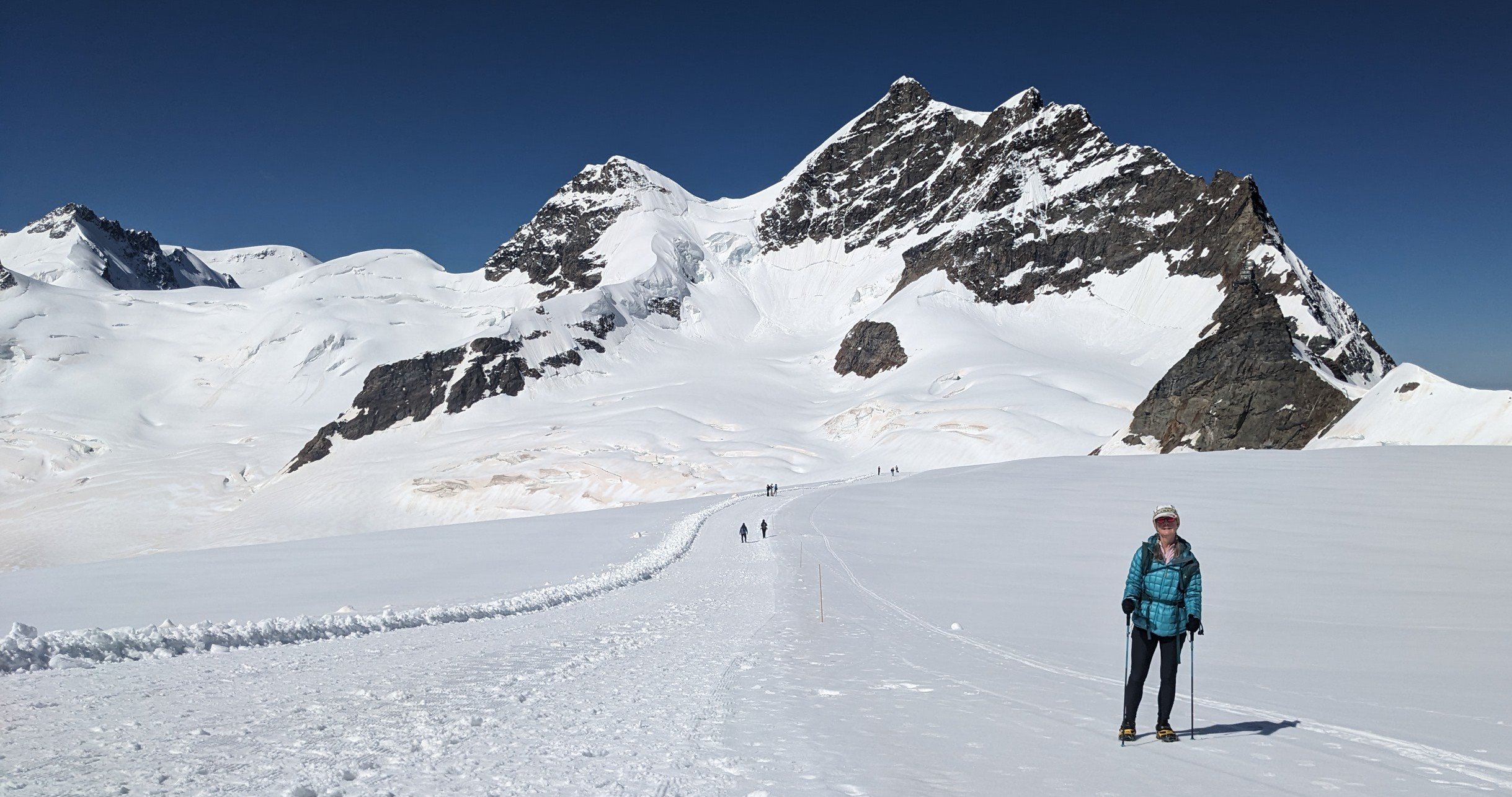
Between Jungfraujoch and Monchsjochhutte
After our day off (in which we still did two short walks!), this was a long day and our feet felt a bit pounded by the end, not least because it was very hot all day. The route took us down what became quite a tough descent close to the foot of the Jungfrau with excellent views of its pyramidal sub-peak, the Silberhorn, to the Trummelbach Falls, followed by a few welcome flat kilometers along the valley bottom to Stechelberg. Officially, this day’s stage ends here, but we had been unable to book accommodation at either of the two berghotels in the village, and so we ended the afternoon with a hot ascent to Murren (and as a result were once again ‘off’ the official TJR route). No-one else was ascending – they had all gone up in the gondola and were sauntering back down!
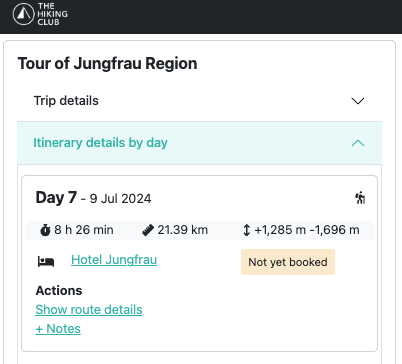
Day 7 hiking stats for Sam and Steve’s itinerary, as displayed in The Hiking Club planning app.
Today took us from the Grindelwald into the Lauterbrunnen valley, which was interesting in itself, and we also noted this was the lowest altitude we’d been at for a week; it felt different and gave us a better sense of just how high the mountains here are, as we were so far below them. After a welcome shower at our hotel (Hotel Jungfrau Murren) and a beer, we ate another rosti at Hotel Alpina which had amazing views across the valley.

Lauterbrunnen valley looking towards Breithorn and Tschingelhorn
Murren was noticeably quieter this morning, the gondola and train having yet to start running! After another lovely Swiss breakfast of scrambled egg, cheese, fresh fruit and seeded bread, we set off down to Gimmelwald via the Co-op (to stock up on peanuts and dried apricots), one of the few shops on our trek. We were heading back onto the official TJR route, but doing this and the next stage in the opposite direction due to our starting and end points. We headed down to Im Tal, crossed the river then walked steeply uphill in woodland for over two hours to Tanzbodeli, a flower-filled plateau.
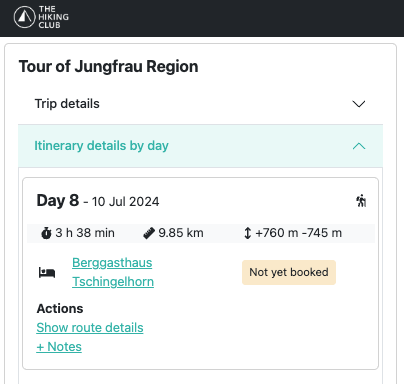
Day 8 hiking stats for Sam and Steve’s itinerary, as displayed in The Hiking Club planning app.
After early light rain showers the cloud lifted and the sun came out. We descended from the plateau and contoured to Obersteinberg for a beer. Not much fancying a night of cold showers and no electricity (apparently these are ‘attractions’ of Berggasthaus Obersteinberg!), we headed 15 minutes down the valley to Berggasthaus Tschingelhorn, where we had a lovely wooden room with a balcony and chairs. We took advantage of a shorter day and rested our tired legs, planning our onward route as our plans to get up to the Schilthorn were well and truly scotched by a combination of not being able to get a bed at the Rostock Hut along with rain and low cloud forecast.
We have a rule about not going up a mountain for the sake of ticking it off: what is the point of doing it if you can’t see anything, particularly if the weather is going to be miserable. The evening meal was tasty (Thai soup, falafels and pasta) which we ate watching goats play outside.

On the Tanzbodeli
Today was a great route, taking us high up into the Oberhornsee hanging valley, though it felt like a longer day than it was! An easy longish ascent brought us to the small lake: Oberhornsee, which was beautiful and we spent a long time looking at the mountains being reflected in it and taking photos.
There were a few people on the trail but not many; much of today felt more remote than some of the other stages due to the lack of transport to bring tourists up here, to what is effectively the head of the Lauterbrunnen valley. After a short out and back to the Schmadri Hut (unmanned – we just went for the extra ascent!), we headed down some tricky terrain which slowed us down, along with hot and humid weather. We stopped for a refreshing cold drink and apricot tart at Trachsellauenen.
Our accommodation at the Mountain Hostel at Gimmelwald required yet another ascent at the end of the day, and we were pleased to have a beer and a surprisingly tasty pizza here. At one point the heavens opened and some very heavy rain came down. We slept well despite it being a hostel full of what seemed to us very young people!

Reflections in the Oberhornsee
As above, weather and accommodation options put paid to us sticking to the TJR (which would have taken us up and over the Schilthorn) for the next few days, so we made up our own trek. Today we woke to overcast skies with heavy rain forecast, requiring a very short day. We embarked on a local route called the North Face Trail (nothing to do with the clothing brand!) which zigzagged above Gimmelwald and Murren and had information boards at regular points explaining ascents of the north faces of all the mountains opposite us.
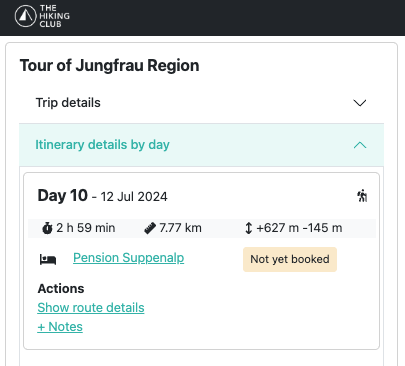
Day 10 hiking stats for Sam and Steve’s itinerary, as displayed in The Hiking Club planning app.
Despite the cloudy day, it was (at this point) high cloud and gave us the best views so far of the high peaks opposite. We kept looking up at the Schilthorn above us and were tempted to give it a go, but stuck to our plans and headed straight to the Blumental and Pension Suppenalp. After some lunch we left our rucksacks and took a stroll over to the gondola station at Allmenhubel, but rain and cool winds drove us back; the cloud was down and we were satisfied with our decision not to attempt the Schilthorn in what would have been challenging conditions with no view. Sometimes the weather wins, At least we have an excuse to go back!

In the mist at Allmendhubel
Today we were headed to Wengen where we’d decided to spend three nights so as to extend the TJR, to see some of the local walks not on the official route, and to cook our own veggie food. Our only objective was to reach Wengen. We headed off into low cloud and drizzle again, and saw only a few other walkers. Towards Grutschalp we took a continuation of the North Face trail which is effectively a balcony route high on the west side of the valley. We extended our walk beyond Grutschalp in the hope of better weather coming in, but as this didn’t happen we had a coffee at the gondola station and walked down to Lauterbrunnen.
The town was very busy so we didn’t linger and headed straight up to Wengen, a lovely village which seemed to be very busy at weekends but much quieter in the week. After checking into our self-catering somewhat bijou studio, we found a launderette and supermarket, then cooked bean, lentil and vegetable stew which we ate for the next three days – we needed a break from cheese and potatoes! The cloud stayed down all evening and it was noticeably cooler.

Looking down at Lauterbrunnen
Our first full day in Wengen turned out to be one of the best days on the whole TJR (even though it’s not on the TJR!), as the views from Mannlichen were amazing! From the top we could see the whole TJR route - both valleys and all the mountains. We were surprised that Mannlichen is only included as an optional side trip from Kleine Scheidegg on the official tour.
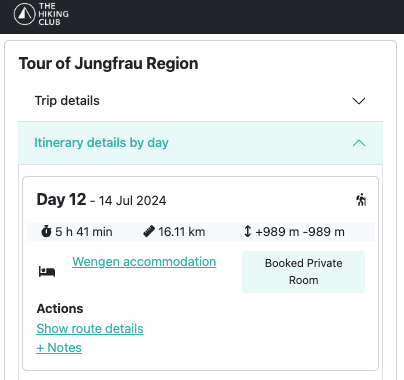
Day 12 hiking stats for Sam and Steve’s itinerary, as displayed in The Hiking Club planning app.
We took a very steep ascent up the Gemsweg (path of the chamois) to the gondola station just below the summit on what turned out to be a gorgeous sunny day with full visibility - apart from cloud stubbornly hanging on the Schilthorn! The summit was heaving with tourists, so after marvelling at the panoramic views of the TJR, we pressed on towards Kleine Scheidegg on a contouring route which was quite busy.
Before reaching the village, we headed up onto a higher contour around the summit of the Lauberhorn which was much quieter. The descent down a ski piste towards the Lauterbrunnen/Kleine Scheidegg railway line was steady but tough on the legs as it was sustained and lengthy. We stopped around 30 minutes short of Wengen at Allmend for a beer then headed back to Wengen, where we ate on our balcony looking at the outstanding view up to the Breithorn.

Panorama Grindelwald valley from Mannlichen
Having decided to treat today as a short/rest day, we did a local walk in lovely sunshine which took us up and along to Spatenenalp then back via the Leiterhorn viewpoint. This was useful as it gave us a good insight into tomorrow’s route (back up to Grutschalp, along and down to Wilderswil). The rest of the day comprised reading on the balcony, a short walk around the village, and culminated in a massive electric thunderstorm which we watched from the balcony around 7pm.

View from Spatenalp
Our last day! Fortunately the weather was much better than anticipated but everything was very wet underfoot after last night’s rain. Most paths were mud or streams or super slippy wet limestone and tree roots. We walked down to Lauterbrunnen and decided to cut out around 1.5 hours of ascent (which we’d already done in the other direction) back up to Grutschalp by taking the gondola. From there, it was a really nice route contouring through trees which then opened up eventually to the Lobhorn Hut; we ate our lunch by the little lake there.
Onwards there was a little more ascent to cross a very stony corrie, the Tolkienesque Sylertal, where we followed a solitary chamois along the path. We finally began the long descent through woods all the way down to Wilderswil. Here we took the most direct route back to the village which zigzags north past the Schwarzhore rather than the official route via Saxeten. It was somewhat knee jarring and a bit mind bending – a good mental test! However, with hindsight we should have stuck to the suggested route as it probably offered a gentler and more interesting descent than the steep woods!
Towards the end we stopped at a memorial for 1998 flash flood disaster victims, which was sobering. After arriving at our final hotel (Hotel Edelweiss), a shower then a beer plus another fondue concluded our trek. Our legs were tired but as ever we were pleased we completed it and ready to eat anything but cheese!

Lunch spot on last day
Additional notes:
A note about the Eiger North Face and the train – the train passes the window in the north face where rescuers got tantalisingly close to rescuing poor Toni Kurz in 1936. Only 23 years old, he died just feet away from them, unable to abseil past a knot in his rope. The excellent documentary that tells Toni’s story (“The Beckoning Silence”) is essential preparation for staring in awe at the North Face and a sombre antidote to the ‘theme park’ at the Jungfraujoch.
To help understand the lay of the land, think of the TJR as being scruffily hung around a letter L which has rotated 90 degrees clockwise. West/east is the Grindelwald valley, south/north the Lauterbrunnen valley. The route in effect follows the skyline of these two. Mannlichen sits at the apex. It is almost too much to take in – which is why the TJR is so different from most linear long distance routes. Here, at Mannlichen, your entire trip is set out as a wonderful 360 degree panorama.
Updated 13th May 2026.
As part of our acquisition of TMB Planner, we’ve integrated technology into our app to check bed availability for mountain huts. At time of launch, we foucsed on properties along the Tour du Mont Blanc trail. However, we’ve now extended the same technology all of our trails, including Alta Via 1, Walker’s Haute Route, West Highland Way, Tour of Monte Rosa, Bernese Oberland, Tour des Combins, Alta Via 2, Tour of Jungfrau and Via Alpina Switzerland.
The scope of mountain huts is limited to those which list their availability online. We can not provide availability data for mountain huts that do not list their availability online, for example, those properties requiring bookings to be made via phone, email, or submitting an online form.
In our accommodation database, we also have many more accommodation types along the trail, such as hotels, campgrounds and bivouac locations. Where an accommodation location lists their availability online, such as hotels, we have an ongoing initiative to integrate their availability data into our app. For the 2027 season, we are able to display available beds for ~130 properties.
If the accommodation location is one of the following, there is no availability data that we can provide you;
Bivouac or wild camping locations
Campgrounds that don’t accept/need bookings
Accommodation that don’t list their availability online
A general accommodation location rather than being for a specific property
Confirmed Integration (2026 Season)
Albert Premier Hut
Au Coeur Des Neiges
Auberge de Maya-Joie
Auberge des Glaciers
Auberge du Mont-Blanc
Auberge du Truc
Auberge la Boerne
Auberge la Grande Ourse
Chalet CAF des Contamines
Chalet CAF du Tour
Chalet La Grange
Chalet Le Dolent
Chalet Les Meandres (ex Tupilak)
Chalet-hotel Gai Soleil
Chamonix Lodge
Gite Alpage de La Peule
Gite Bon Abri
Gite d'Alpage Les Ecuries de Charamillon
Gite de la Fouly
Gite de La Lechere
Gite Le Moulin
Gite le Pontet
Gite le Randonneur du Mont Blanc
Gite Les Melezes
Gite Mermoud
Gite Michel Fagot
Hotel Chalet Val Ferret
Hotel Col de la Forclaz
Hotel de La Couronne
Hotel du Col de Fenetre
Hotel Edelweiss La Fouly
Hotel Funivia
La Ferme a Piron
Les Chambres du Soleil
Pension en Plein Air
Refuge de la Balme
Refuge de la Croix du Bonhomme
Refuge de la Nova
Refuge des Mottets
Refuge des Pres
Refuge du Col de Balme
Refuge du Fioux
Refuge la Roselette
Refuge Le Peuty
Refuge Nant Borrant
Relais d'Arpette
Rifugio Bertone
Rifugio Elena
Rifugio Maison Vieille
Rifugio Monte Bianco
Robert Blanc
Vert Lodge Chamonix
Refuge Lac Blanc
Plus more!
Confirmed Integration (2026)
Albert Premier Hut
Auberge du Mont-Blanc
Auberge la Boerne
Auberge la Grande Ourse
Cabane Brunet
Cabane de la Barmaz
Cabane de Louvie
Cabane de Mille
Cabane de Moiry
Cabane de Prafleuri
Cabane des Dix
Cabane des Ecoulaies
Cabane FXB Panossiere
Chalet CAF du Tour
Chalet La Grange
Chamonix Lodge
Gite Bon Abri
Gite d'Alpage Les Ecuries de Charamillon
Gite Le Moulin
Gite Mermoud
Gite Michel Fagot
Hotel Col de la Forclaz
Hotel de La Couronne
Pension en Plein Air
Refuge du Col de Balme
Refuge Le Peuty
Relais d'Arpette
Taschhutte
Topalihutte
Turtmannhutte
Vert Lodge Chamonix
Chamonix Lodge
Plus some additional properties in villages
Confirmed Integration (2026 Season)
Rifugio Averau
Rifugio Biella
Rifugio Bruto Carestiato
Rifugio Coldai
Rifugio Col Gallina
Rifugio Croda da Lago
Rifugio Fanes
Rifugio Fodara Vedla
Rifugio Lagazuoi
Rifugio Lavarella
Rifugio Mario Vazzoler
Rifugio Passo Duran
Rifugio Passo Staulanza
Rifugio Pederu
Rifugio Scoiattoli
Rifugio Scotoni
Rifugio Sora'l Sass
Rifugio Tissi
Rifugio Angelo Dibona
Planned Integration (2026 Season)
Rifugio Dal Piaz (CAI)
Rifugio Pisciadu (CAI)
Rifugio Puez (CAI)
Rifugio Castilglioni Marmolada
Rifugio Boz (CAI)
Rifugio Boe (CAI)
Confirmed Integration (2026 Season)
Rifugio Tre Scarperi / Dreischusterhuette
Rifugio Locatelli / Dreizinnenhuette
Rifugio Lavaredo
Hotel Sorapiss
Rifugio Pietro Galassi
Confirmed Integration (2026 Season)
Auberge de Maya-Joie
Auberge des Glaciers
Cabane Brunet
Cabane de Chanrion
Cabane de Louvie
Cabane de Mille
Cabane FXB Panossiere
Chalet La Grange
Chalet Le Dolent
Gite Bon Abri
Gite de la Fouly
Gite de La Lechere
Great St. Bernard hospice
Hotel du Col de Fenetre
Hotel Edelweiss La Fouly
La Tsissette Hut
Mont-Joux Auberge
Pension en Plein Air
Rifugio Champillon
Rifugio Frassati
Confirmed Integration (2026 Season)
Albergo Ristoro Sitten
Britannia Hut
Taschhutte
Topalihutte
Turtmannhutte
Confirmed Integration (2026 Season)
Balmhornhuette
Berghaus Alpiglen
Berghaus Baeregg
Berghaus Maenndlenen
Bluemlisalphuette SAC
Brochhuette SAC
Doldenhornhuette SAC
Glecksteinhuette
Gspaltenhornhuette SAC
Lobhornhuette
Rotstockhuette
Schreckhorn Hut
Confirmed Integration (2026 Season)
Berghaus Alpiglen
Berghaus Baeregg
Berghaus Maenndlenen
Bluemlisalphuette SAC
Brochhuette SAC
Doldenhornhuette SAC
Glecksteinhuette
Gspaltenhornhuette SAC
Rotstockhuette
Schreckhorn Hut
Confirmed Integration (2026 Season)
Berghaus Alpiglen
Berghaus Baeregg
Berghaus Maenndlenen
Brochhuette SAC
Glecksteinhuette
Lobhornhuette
Rotstockhuette
Schreckhorn Hut
Confirmed Integration (2026 Season)
Ardess Lodge & Ben Lomond Bunkhouse
Ashbank B&B
Balmaha Bunkhouse
Bank House Guesthouse
Braeside Guest House
Craigbank Guest House
Forest View Guest House
Glenardran House guest house
Greenstone Lodge B&B
Inversnaid Bunkhouse
Inversnaid Hotel
MacDonald Hotel & Cabins
Ossians Hotel
Shandon Farmhouse
The Drovers Inn
West Highland Way Lodge
So you’re interested in hiking the Haute Route from Chamonix to Zermatt but want to camp, instead of staying huts, hotels or B&Bs each night? Great choice! Although the idea of spending each night under the stars is an idyllic option, you need to be aware of where you can actually camp along the Haute Route, as there are very strict rules put in place by the National Parks and local governments.
Over the past few years, we’ve gathered the latest information on where you can wild camp, campgrounds with facilities and mountain huts that allow you to camp nearby. About 20% of our customers use our platform to plan and navigate their camping adventure along the Haute Route. Read on to learn about the various camping options, the cost estimates for camping and other useful tips to help you prepare for camping the Walker’s Haute Route.
Updated for the 2026 season.
Have you started planning your Alta Via 1 Dolomites hike in the usual 11 stages and finding fully booked locations for the dates you want?
You’re not alone!
Accommodation booking anxiety is experienced by most self-guided hikers that book their own accommodation…and a popular conversation topic on the trail :)
When accommodation availability becomes scarce, this 6-day itinerary can keep your Alta Via 1 dreams alive! Staying at villages and using transport provides you a much needed bed and allows you to hike 100km / 62mi along the Alta Via 1 route. You can opt to use just one, a few or all days to make your hike happen.

Average daily stats:
Distance: 17km / 11mi
Elevation gain: 950m / 3,100ft
Time (steady pace): 6 hours, not including breaks
Accommodation: Staying in villages that have the most accommodation options
This 6-day itinerary for the Alta Via 1 Dolomites gets around all of the Northern locations that are typically booked out…without needing to do any camping!
The Hiking Club has always championed self-guided hikers who want to stay in control of their itinerary and costs, by planning and booking their own trips. We have over 7 years of experience creating itineraries that are available to book at any time of the year. Our trip planning app is the 3rd generation of our self-planning product that gives hikers the power to easily create an achievable, inspiring, and available-to-book itinerary in one session.
If you want some assistance in designing an itinerary that is ready for you to book based on your specific dates and requirements, we can do this via our Expert Access package.

day 1: lago di braies to san vigilio
The first stage travels through the Fanes, Sennes, Braies Natural Park, with 4 rifugios to choose from (Biella, Sennes, Fodara Vedla and Pederu). Once these are booked up, hikers have three options to overcome fully booked locations here:
Set cancelled bed alerts at Rifugio Biella, Rifugio Fodara Vedla and Rifugio Pederu.
Continue hiking into Fanes section of Natural Park (Total 22km / 14mi) to reach 3 more accommodation options (Ucia dles Muntagnoles, Fanes, Lavarella)
Catch the bus to stay in San Vigilio for the night. It takes 20 minutes and has 20+ hotels, b&bs, holiday rentals and campgrounds for hikers to choose from. In the morning, catch the same bus back to the trailhead to continue your hike.
Click to expand. The trip planning app is included in all self-guided packages.

day 2: san vigilio to san cassiano
One of the most popular rifugios on the AV1 is Rifugio Lagazuoi. It (and surrounding rifugios) often book out quickly for peak dates and therefore forces hikers to either hike a longer day to find accommodation or use public transport to reach a nearby village.
For those that can’t find accommodation along the trail at popular rifugios (including Lagazuoi, Scotoni, Valparola, Col Gallina), the best option is:
Set cancelled bed alerts at Rifugio Lagazuoi, Rifugio Scotoni and Rifugio Col Gallina
Catch the bus from either Sciare or Passo Falzarego to San Cassiano for the night. There are 15+ hotels, b&bs and holiday rentals to choose from. In the morning, catch the same bus back to the trailhead to continue your hike.
Click to expand. The trip planning app is included in all self-guided packages.

day 3: san cassiano to cortina
There are 6 rifugios in and around the Cinque Torri and Nuvolau area [Cinque Torri, Scoiattoli, Averau, Nuvolau, Fedare and Berghotel Passo Giau]. If these are all booked out on your dates, it is too far to continue on to Citta di Fiume, the next rifugio along the trail.
Therefore, the best options are:
Set cancelled bed alerts at Rifugio Scoiattoli, Rifugio Averau
Consider whether Rifugio Dibona, Rifugio Col Gallina, Rifugio Croda da Lago, Rifugio Malga Fedare are suitable alternatives for your itinerary
Finish your hike at Cianzope bus stop and catch the 20 minute bus into Cortina, where there is lots of accommodation to choose from.
Finish you hike at Cianzope bus stop and catch 2 buses to San Cassiano, if you plan to stay there the previous night. Therefore you can hike today with just a daypack (luxury!).
Click to expand. The trip planning app is included in all self-guided packages.

day 4: cortina to pescul
If you are unable to secure accommodation at Rifugio Citta di Fiume, Aquileia or Passo Staulanza, your options are:
Continue hiking to Rifugio Palafavera (Total 27km / 17mi)
Set cancelled bed alerts for Rifugio Staulanza
Finish your day by taking an alternative trail to Pescul, a small town with 10+ hotel, b&b and holiday rentals to choose from.
Click to expand. The trip planning app is included in all self-guided packages.

Day 5: Pescul to alleghe
If you are unable to secure accommodation to Rifugio Coldai, Tissi or Vazzoler, then you’ll need to find accommodation in Alleghe for the night:
Catch the gondolas down to Alleghe, a small town with 10+ hotel, b&b and holiday rentals to choose from. In the morning, catch the gondolas back to the trailhead to continue your hike. If you are feeling energetic, you could walk this section, rather than take the gondola.
Set cancelled bed alerts at Rifugio Coldai, Tissi and Vazzoler
Consider hiking to Rifugio Capanna Trieste (distance dependant on departure location)
Click to expand. The trip planning app is included in all self-guided packages.
day 6: alleghe to listolade
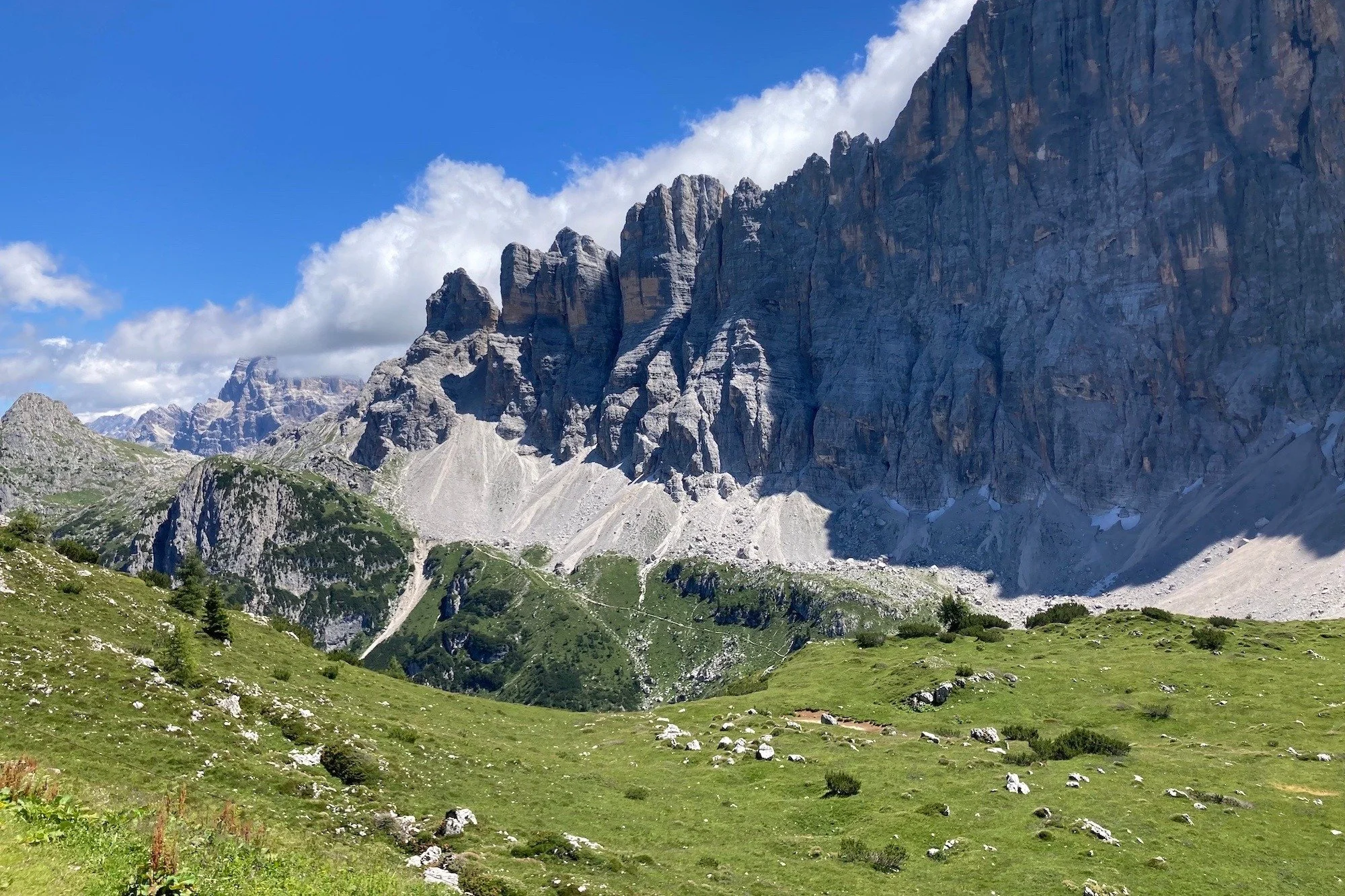
If you are unable to secure accommodation at Rifugio Carestiato, San Sebastiano, Passo Duran or Malga Calleda, then there are three options:
Set cancelled bed alerts for Rifugio Carestiato and Rifugio Passo Duran
Continue hiking to Rifugio Pramperet (Total 35km / 22mi)
Finish you day (and your hike!) by taking an alternative route down to Listolade, a small village on the main road between Alleghe and Belluno. From here you can choose to catch a bus back to Alleghe, to Agordo for the closest accommodation, or all the way to Belluno, where you can stay or catch bus/train on to Venice or Cortina.
Click to expand. The trip planning app is included in all self-guided packages.
optional day 7: passo duran to forno di zoldo
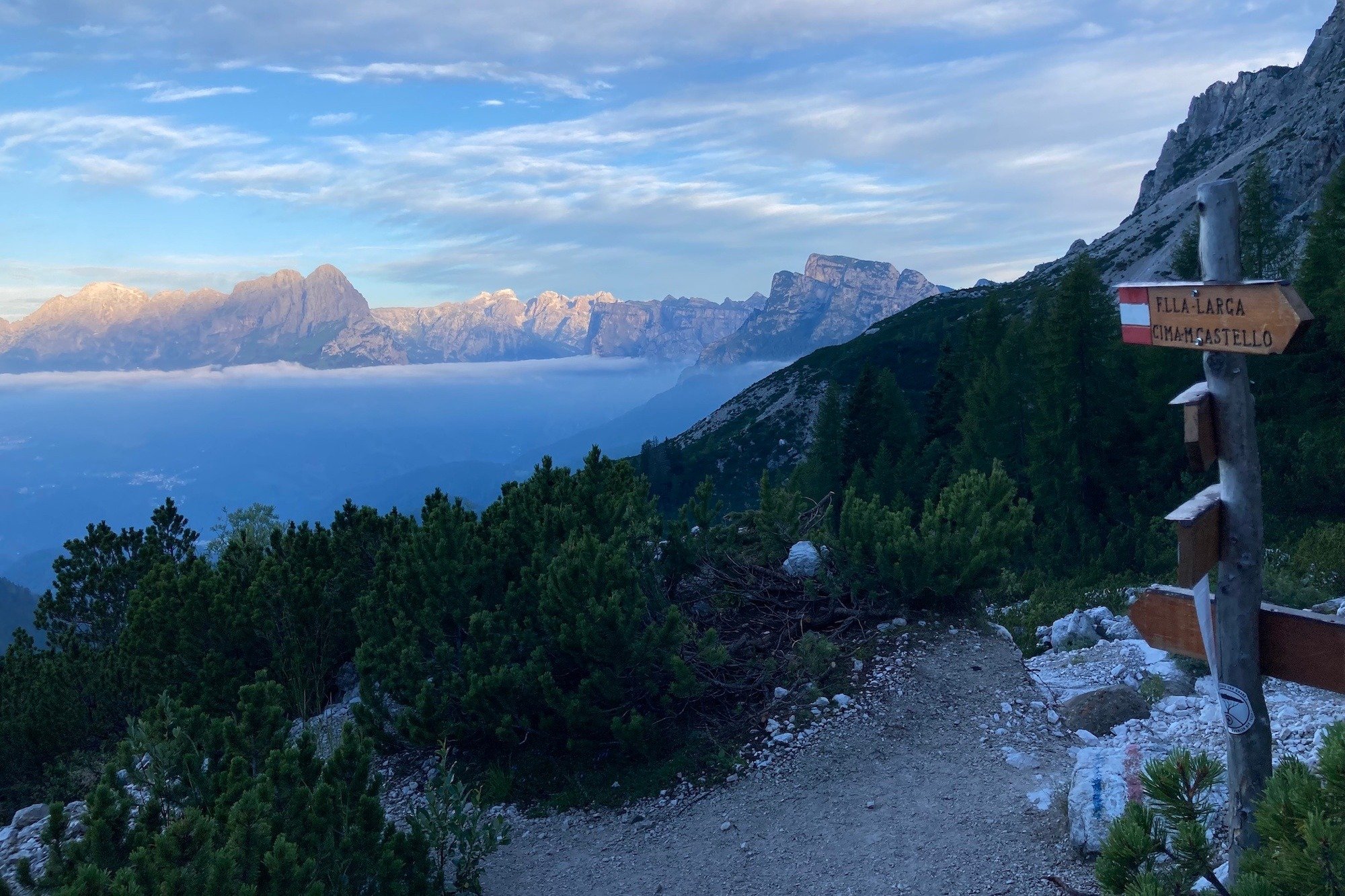
If you have been able to secure accommodation at one of the 4 rifugios near Passo Duran, including Rifugio Passo Duran, San Sebastiano, Carestiato and Malga Calleda, then you can continue your hike south. The next difficult spot to secure accommodation is Rifugio Pramperet, Malga di Pramperet and Rifugio Pian de Fontana. If you are unable to get a bed in one of these locations, you will need to:
Finish your day by hiking an alternative route to Forno di Zoldo, a small town with 10+ hotels, b&bs, holiday rentals and campground to choose from. There is a shuttle bus to reduce the last stretch of this section
Many people that stay in Forno di Zoldo, choose to finish their hike here. Otherwise it is necessary to retrace all the way back to Rifugio Pramperet to continue on the main trail to the official finish point, La Pissa Bus Stop, or via Soffranco/Longarone on the alternative route.
Click to expand. The trip planning app is included in all self-guided packages.
So there you have it. The “AV1 6 Day Anytime” itinerary for those booking in October, January, March or July. This itinerary can provide you accommodation options to make you Alta Via 1 journey a reality!
Oh and if you want the “AV1 6 Day Anytime” itinerary, it’s available in our itinerary library so all you need to do is buy a self-guided AV1 package and this itinerary can be loaded straight into your app for planning, booking, and navigating!
Updated for the 2026 hiking season.
Have you started planning the Tour du Mont Blanc in the usual 11 stages and finding fully booked locations for the dates you want?
You’re not alone!
Accommodation booking anxiety is experienced by most self-guided hikers that book their own accommodation…and a popular conversation topic on the trail :)
When accommodation availability becomes scarce, this 11-day itinerary will keep your TMB dreams alive! Staying at villages and using transport provides you a much needed bed.

Average daily stats:
Distance: 16.5km / 10mi
Elevation gain: 1,000m / 3,300ft
Time (steady pace): 6 hours, not including breaks
Accommodation: Staying in villages that have the most accommodation options
This 11-day itinerary for the Tour du Mont Blanc gets around all of the locations that are typically booked out…without needing to do any camping!
The Hiking Club has always championed self-guided hikers who want to stay in control of their itinerary and costs by planning and booking their own trips. We have over 7 years of experience creating itineraries for the Tour du Mont Blanc that are available to book at any time of the year. Our trip planning app is the 3rd generation of our self-planning product that gives hikers the power to easily create an achievable, inspiring, and available-to-book itinerary in one session.
If you want some assistance in designing an itinerary that is ready for you to book based on your specific dates and requirements, we can do this via our Expert Access package.

Stage 1: Les houches to les contamines
Les Contamines-Montjoie has 6+ hotels/b&bs/refuges and a range of holiday rentals. Hikers rarely have trouble finding accommodation here due to the large number of beds relative to other stages of the trail.
What do you do if you can’t secure accommodation here?
Set cancelled bed alerts at locations such as Chalet-hotel Gai Soleil, La Ferme a Piron, Chalet CAF des Contamines, Gite Les Melezes
Check booking.com for availability in Les Contamines-Montjoie
The next best option is staying at the cabins at Le Pontet campground
Click to expand. The trip planning app is included in all self-guided packages.
Stage 2: Les Contamines-Montjoie to Les Chapieux
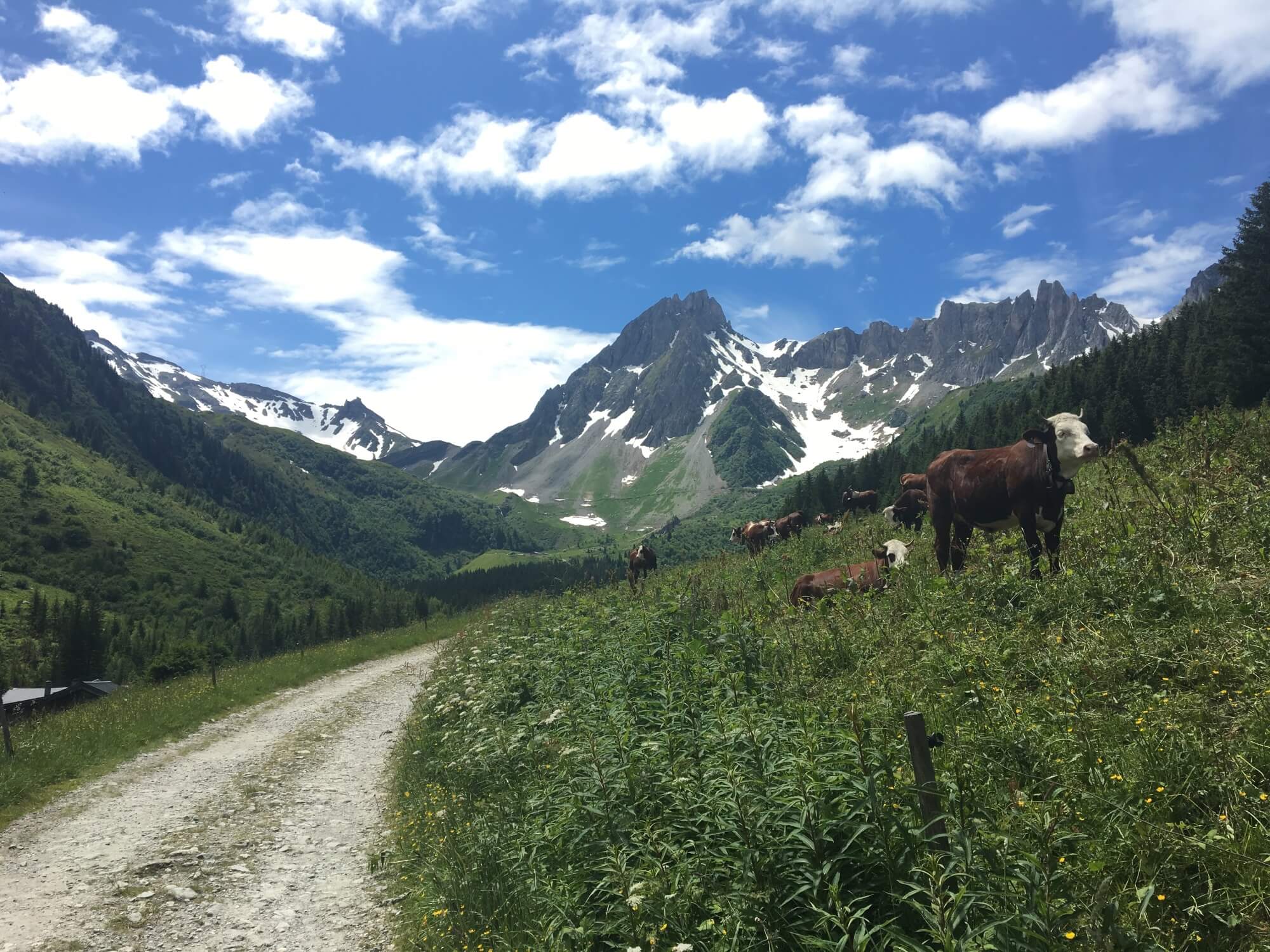
Vallée des Chapieux, which includes Refuge de la Nova, Les Chambres du Soleil and Refuge des Mottets, is usually the first area of the trail to be fully booked. Although there are quite a few beds here, only about 20% are available for hikers booking their own trips, with tour companies putting holds on the rest.
You’ve got three options to overcome fully booked locations here;
Stay at the French alpine club hut Refuge de la Croix du Bonhomme
Set cancelled bed alerts for Refuge de la Nova, Les Chambres du Soleil and Refuge des Mottets
Catch the bus (or arrange a taxi) to stay in Bourg Saint Maurice for the night. It takes about 25 mins to reach Bourg Saint Maurice, and there are many accommodation options here.
Click to expand. The trip planning app is included in all self-guided packages.
Stage 3: Les Chapieux to La Visaille Bus stop
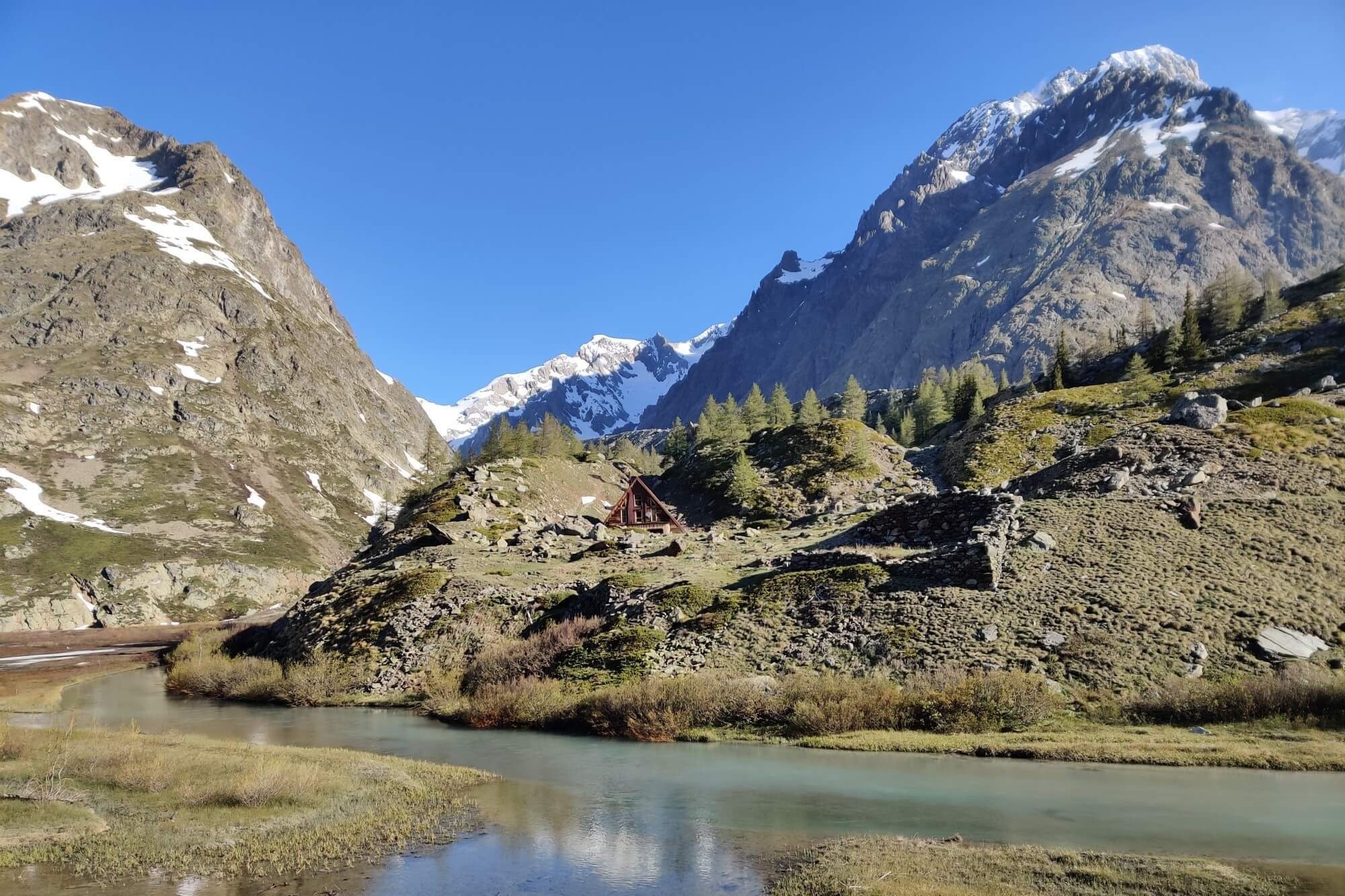
Val Veny in Italy, which includes Rifugio Elisabetta and Cabane Combal, is also an area of the trail where it becomes hard to find availability. The next closest accommodation option is actually in Courmayeur…via the direct bus, which departs from La Visaille and takes about 25 mins. We’ve added a little ‘Courmayeur basecamp’ accommodation location in La Visaille which highlights you’re planning to catch the bus to Courmayeur for the night. See available accommodation in Courmayeur.
The following day, return on the bus to La Visaille and rejoin the main Tour du Mont Blanc trail near Cabane Combal.
Click to expand. The trip planning app is included in all self-guided packages.

Stage 4: La Visaille Bus stop to Courmayuer
Courmayeur has a huge amount of accommodation so finding availability isn’t usually a problem. You can use the bus network to reach properties further south if necessary.

Click to expand. The trip planning app is included in all self-guided packages.

Stage 5: Courmayuer to Arp Nouva bus stop
Most hikers will stay a night between Rifugio Bonatti and Rifugio Elena, however, this area can become booked out. When it does, the next closest accommodation option (once again!) is Courmayeur…via the direct bus, which departs from Arp Nouva and takes about 25 mins. We’ve added a little ‘Courmayeur basecamp’ accommodation location in Arp Nouva, which highlights that you’re planning to catch the bus to Courmayeur for the night. See available accommodation in Courmayeur.
Also, don’t forget to set cancelled bed alerts for locations such as Hotel Chalet Val Ferret and Rifugio Elena.
Click to expand. The trip planning app is included in all self-guided packages.

Stage 6: Arp Nouva bus stop to La Fouly
There is usually a surplus of beds in La Fouly for two reasons;
There is 5+ accommodation options in the area
The next stage is a popular one for hikers to skip (use transport) so some people don’t end up staying around here at all.
For these reasons, La Fouly is one of the last places I recommend people book. Use our live availability feature to see which properties have availability on your target date.
Click to expand. The trip planning app is included in all self-guided packages.

Stage 7: La Fouly to Champex Lac
There is a reasonable range of accommodation in Champex Lac, which is further boosted by additional properties in Champex Den Haut and Arpette, which are within reach for most hikers. It is a popular stand-alone destination for people to visit and stay at during the summer so can be fully booked, especially on Friday and Saturday nights.
What do you do if you can’t secure accommodation in this area?
Set cancelled bed alerts for properties such as Hotel Mont Lac, Pension en Plein Air, Relais d’Arpette, Gite Bon Abri and Chalet La Grange
Check Booking.com for availability in Champex and nearby locations
The next best option is taking a ~20-minute bus to Orsières in the valley below, where there is a great hotel at the station and further transport links to find other accommodation nearby.
Click to expand. The trip planning app is included in all self-guided packages.

Stage 8: Champex Lac to Trient
The Trient Valley, which includes Auberge la Grande Ourse, Auberge du Mont-Blanc, Refuge Le Peuty, and Hotel Col de la Forclaz, is an area of Mont Blanc where most Tour du Mont Blanc and Walker’s Haute Route hikers need to stay - making it hard to find availability.
What do you do if you can’t secure accommodation in this area?
Set cancelled bed alerts for Auberge la Grande Ourse, Auberge du Mont-Blanc, Refuge Le Peuty, and Hotel Col de la Forclaz.
Refuge Les Grands and Refuge Col de Balme are two locations typically within reach of strong hikers and provide idyllic locations to spend a night (note you need to bring your own food to cook at Refuge Les Grands).
An infrequent bus that takes ~10 mins runs from Trient to Le Châtelard-Frontière during July and August, where there is a hotel. The departure times to reach the hotel are okay in the afternoon; however, based on last year’s timetable, you won’t be able to reach Trient until about 10am the following day.
A bus that takes ~45mins to reach Martigny where there is a large range of accommodation. The bus runs about 5 times per day - allowing you to depart for Martigny a few times during the afternoon and return to Trient by about 8am the following day.
Click to expand. The trip planning app is included in all self-guided packages.

Stage 9: Trient to Argentiere
Tre-le-Champ is the usual stop for hikers in this area of the trail with Gite le Moulin the typical alternative which also books out early.
Set cancelled bed alerts for Auberge la Boerne, Gite Le Moulin and Chalet CAF du Tour
Argentiere is the next location to look at with a couple of big hotels in the centre of town and various vacation rentals on the outskirts. See accommodation options.
Click to expand. The trip planning app is included in all self-guided packages.

Stage 10: Argentiere to Plan Praz (Chamonix)
Chamonix has a huge amount of accommodation so finding availability isn’t usually a problem. You can use the train or bus network to reach properties up and down the valley. See accommodation options.
Click to expand. The trip planning app is included in all self-guided packages.

Stage 11: Plan Praz (Chamonix) to Les Houches
Les Houches has 4 main accommodation options. However, 3 of them are not in the village center. Hikers can use the bus network to easily reach Chamonix or other locations with accommodation in the valley.
Click to expand. The trip planning app is included in all self-guided packages.
So there you have it. The “TMB Anytime” itinerary for those booking in October, January, March of July. This itinerary will provide you accommodation options so you can make you Tour du Mont Blanc journey a reality!
If you want the “TMB Anytime” itinerary, it’s available in our planning app so all you need to do is buy a self-guided TMB package and this itinerary can be loaded straight into your app for planning, booking, and navigating!
Sign up to receive regular updates on trail conditions, new products and blog articles about hiking in the Alps.
Please enter a valid email address.
Choose the trails you’re interested in after signing up. Unsubscribe at any time.